Tag Archives: San Bushmen

Southern Namibia

We spent 9 days total in Namibia and it is one of my favourite countries so far. Namibia gained their independence in 1990 from South Africa. Namibia has a heavy German influence which makes for great food but a tough history. The colonization of Namibia was quite violent and up until the 1970’s the Native San Bushmen could be legally hunted like animals. It disgusted me that people used to make handbags out of the San women’s breasts but at that time they were considered non-humans.
San Woman and her cute San Baby

San Woman and her cute San Baby

After the mountains of North Namibia we headed towards the South with Swakopmund being our desired destination. On the way we made a few stops. First we went to a Hierera market. Hierera people wear giant colourful dresses with huge hats of cloth that look like buffalo horns.
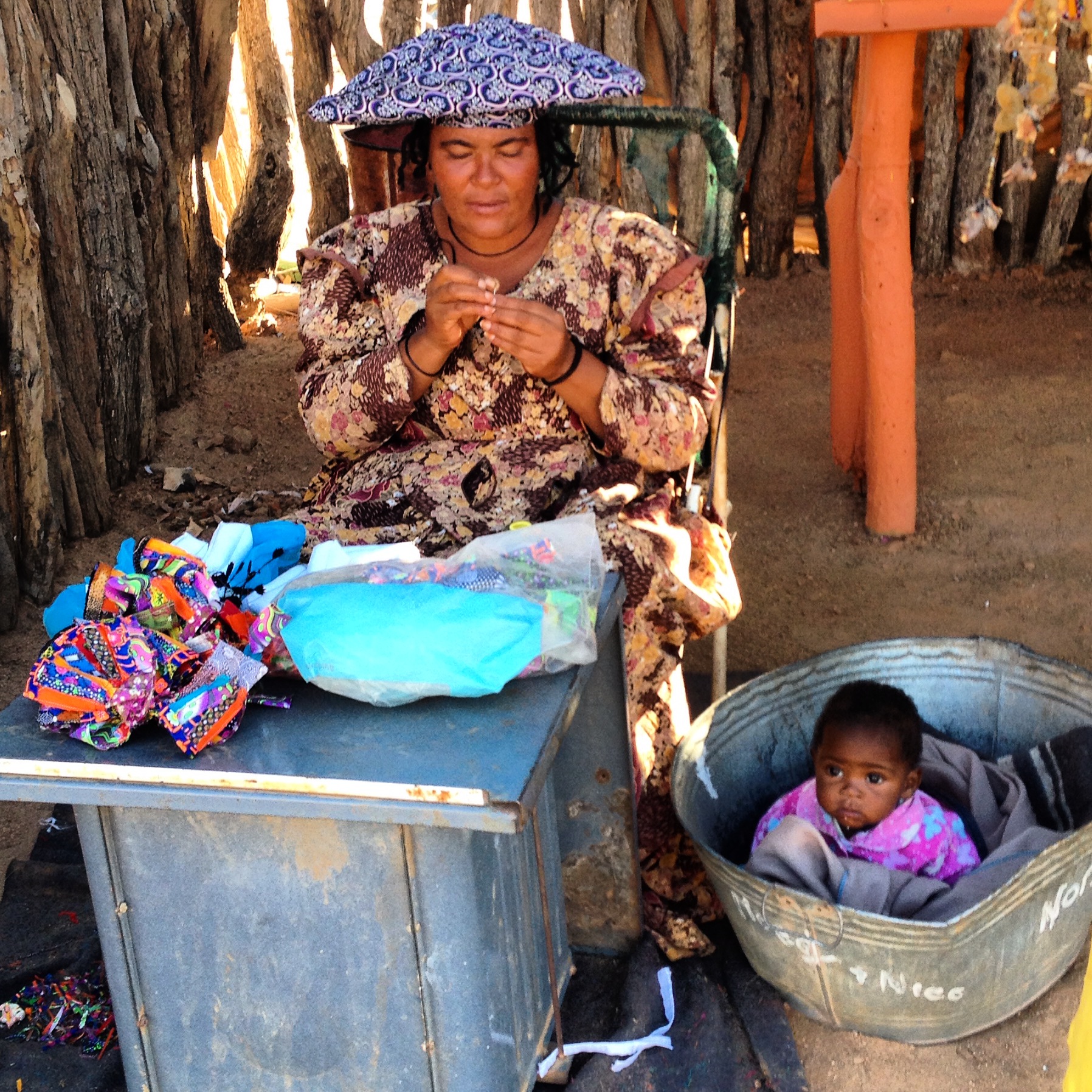
Hierra woman making crafts to sell.

Hierera woman making crafts to sell.

Next we stopped at a Himba market. The Himba people are one of the most photographed tribes in the world. After menstruation the women are not allowed to use water except to drink or cook. Every day the women wake up and perform an hour long ritual that involves rubbing animal fats, sweet smelling herbs, and bright orange mud all over their bodies to cleanse themselves. They also cake the mud onto their hair and leave giant puffs at the bottom of their dreads. They wear headdresses and loincloths made out of hunted animals. They are so exotic looking.
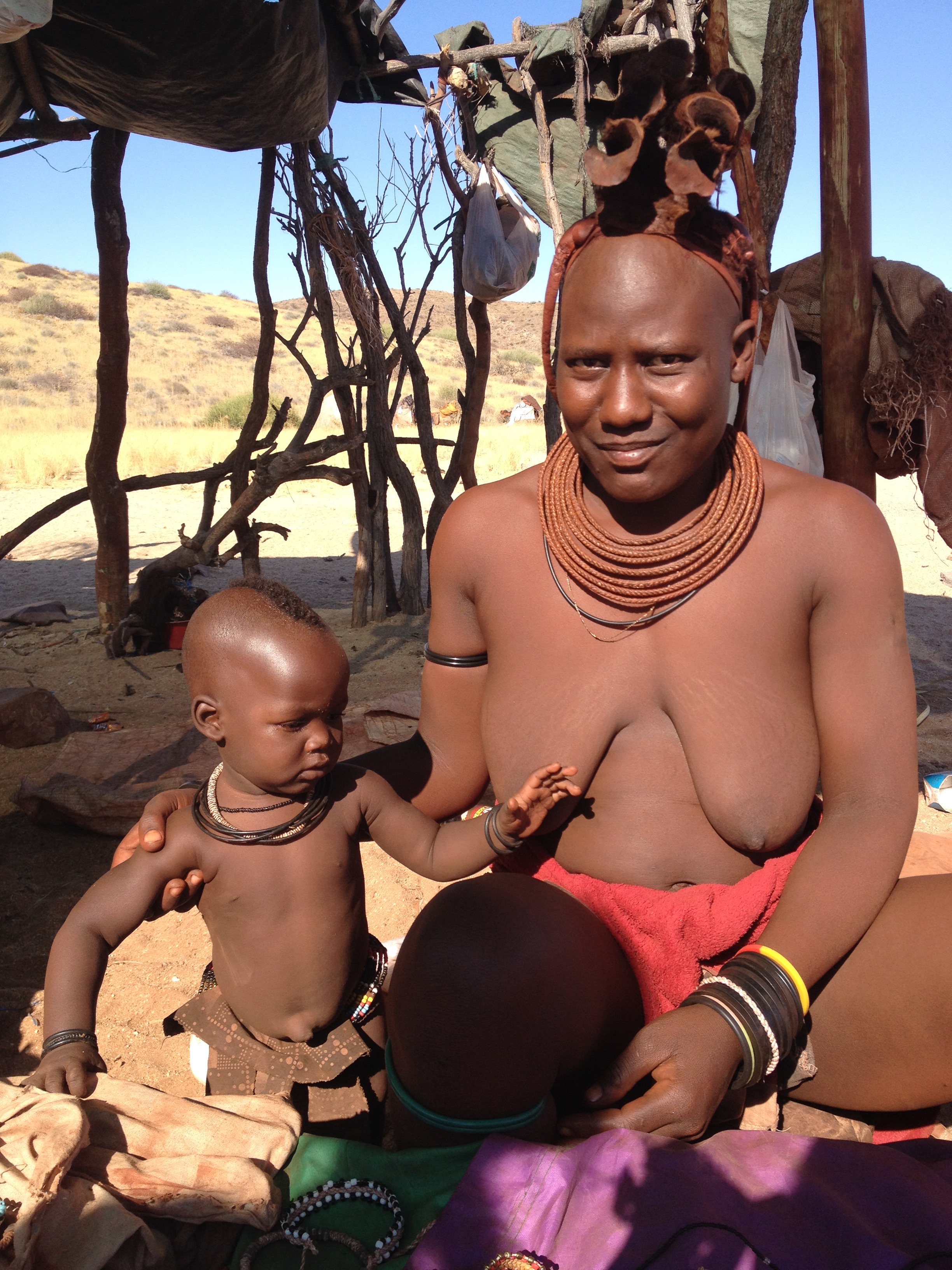
Himba woman.  The fur headdress means that she is married.
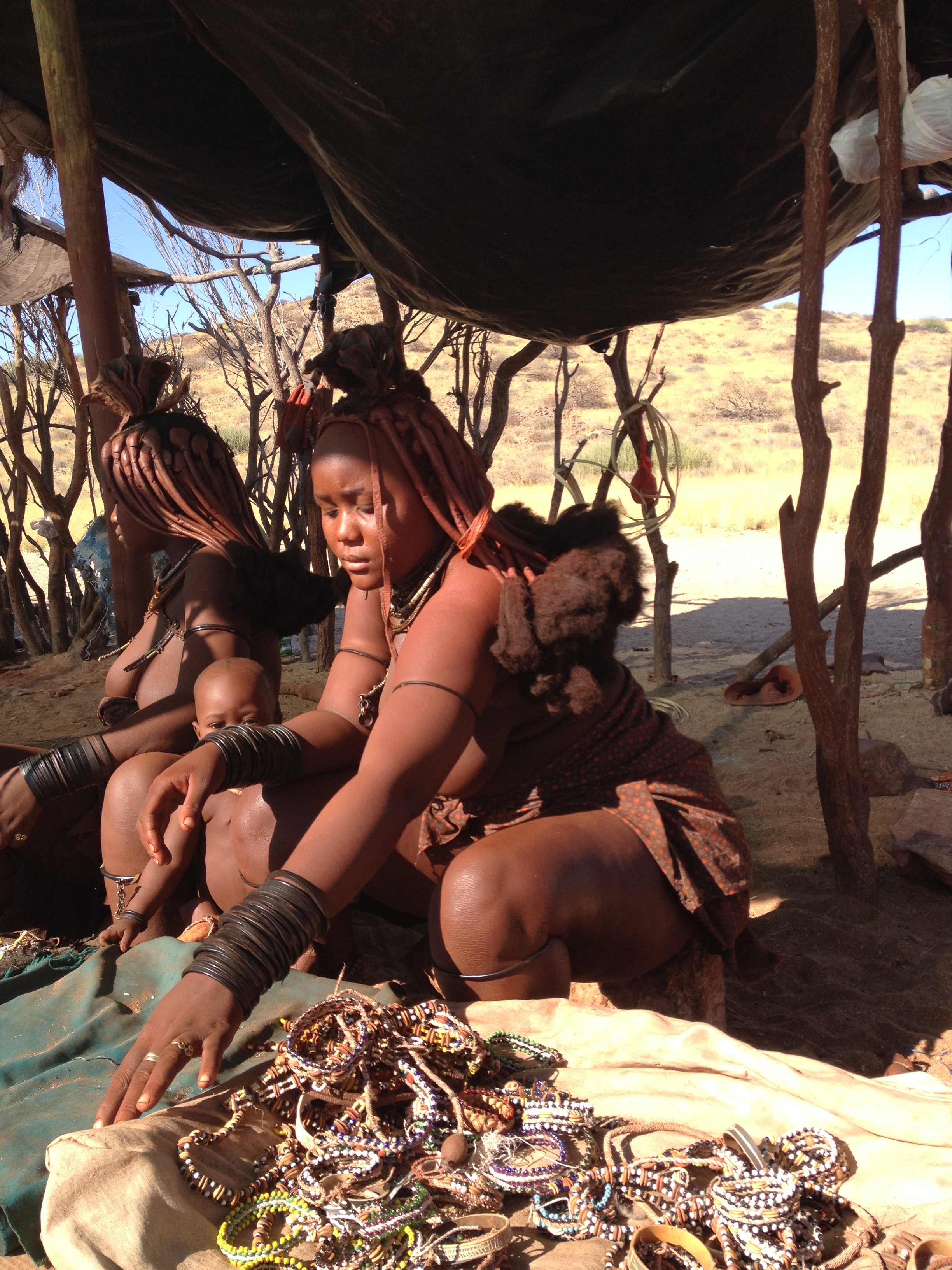
Himba woman. The fur headdress means that she is married.

Himba woman selling her crafts.

Himba woman selling her crafts.

Our last stop on the road trip to Swakopmund was the Skeleton Coast beach. Our guides dared us to jump in the freezing Ocean coming directly from the Antarctica current near one of the many shipwrecks. The Skeleton Coast was given this name because once a crew shipwrecked here they were guaranteed to die because there was only desert for miles.
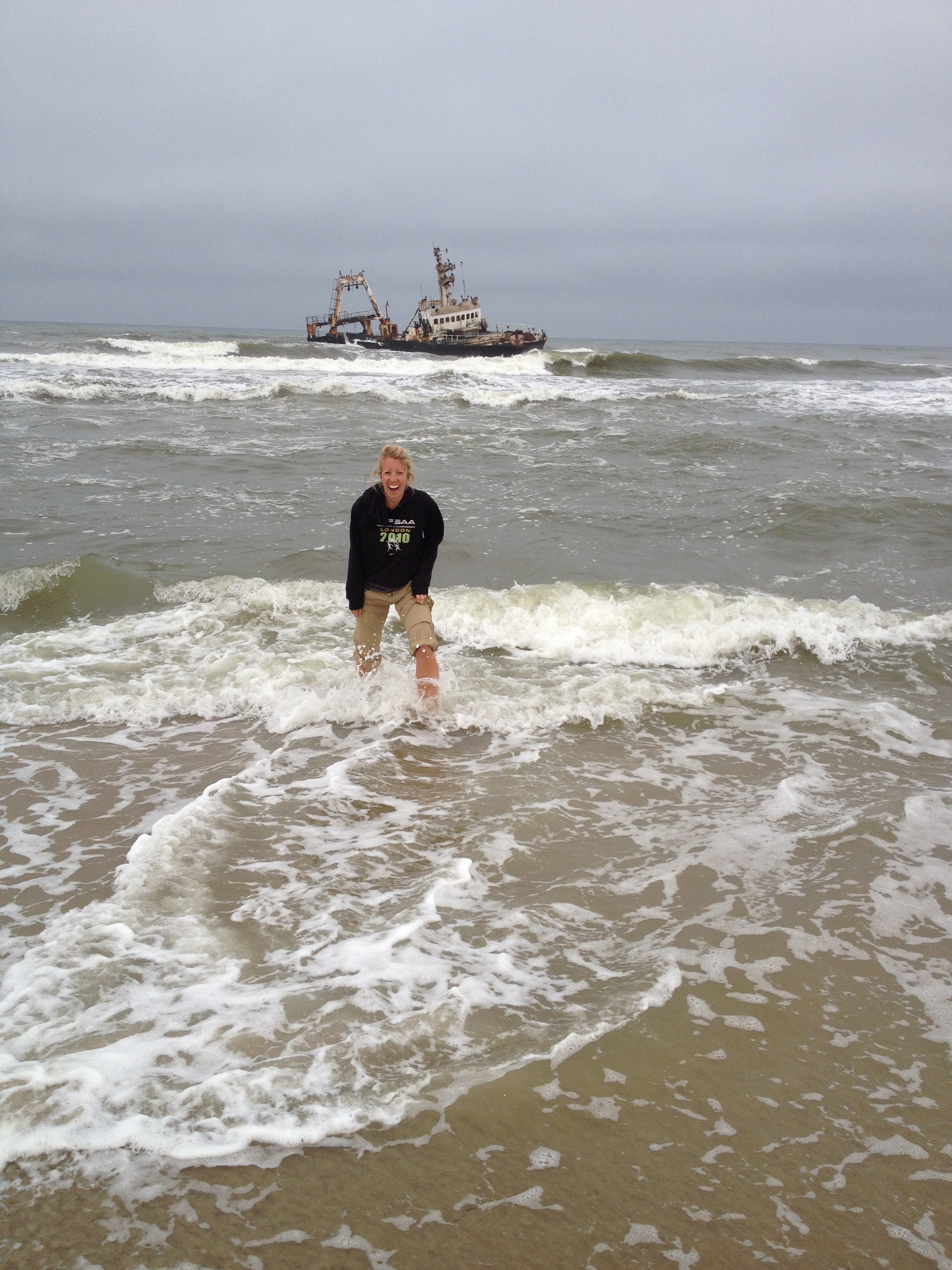
Yarrrgh Maties! It was cold!

Yarrrgh Maties! It was cold!

Alas we reached Swakopmund which looked like a completely different world! The only way I could tell I was still in Africa and not the outlet malls in Florida was the signs saying if you bought a couch you had the chance to win a free sheep! We ditched the tents for 2 nights and stayed in a giant dorm of bunk beds. Following an afternoon of shopping and wandering the streets we went out for a night of dinner and dancing. I cannot stress how weird it felt to be in such a “normal” environment again.
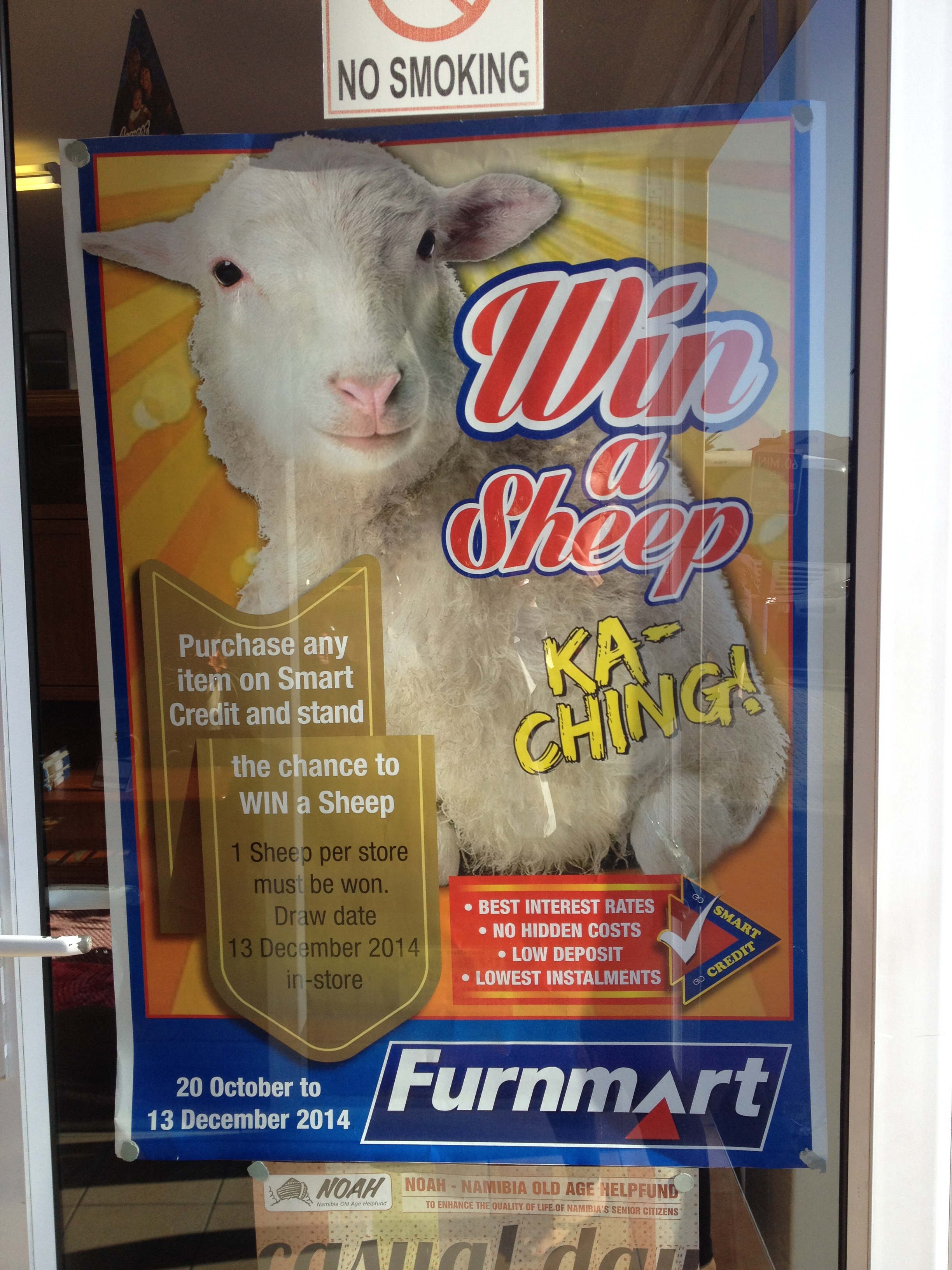
Win a free sheep!

Win a free sheep!

The following day was one of my favourite days of the journey so far. Sandboarding and Quadbiking!!! In the morning we were driven out to the giant star-shaped sand dunes of the Namib Desert. After climbing for what seemed like ages we reached the top with our modified snowboards. At the top we waxed the bottom of the board, clipped in, and set off down the dunes. It was SO much fun and very similar to snowboarding except I could do it in my shorts and sunglasses.
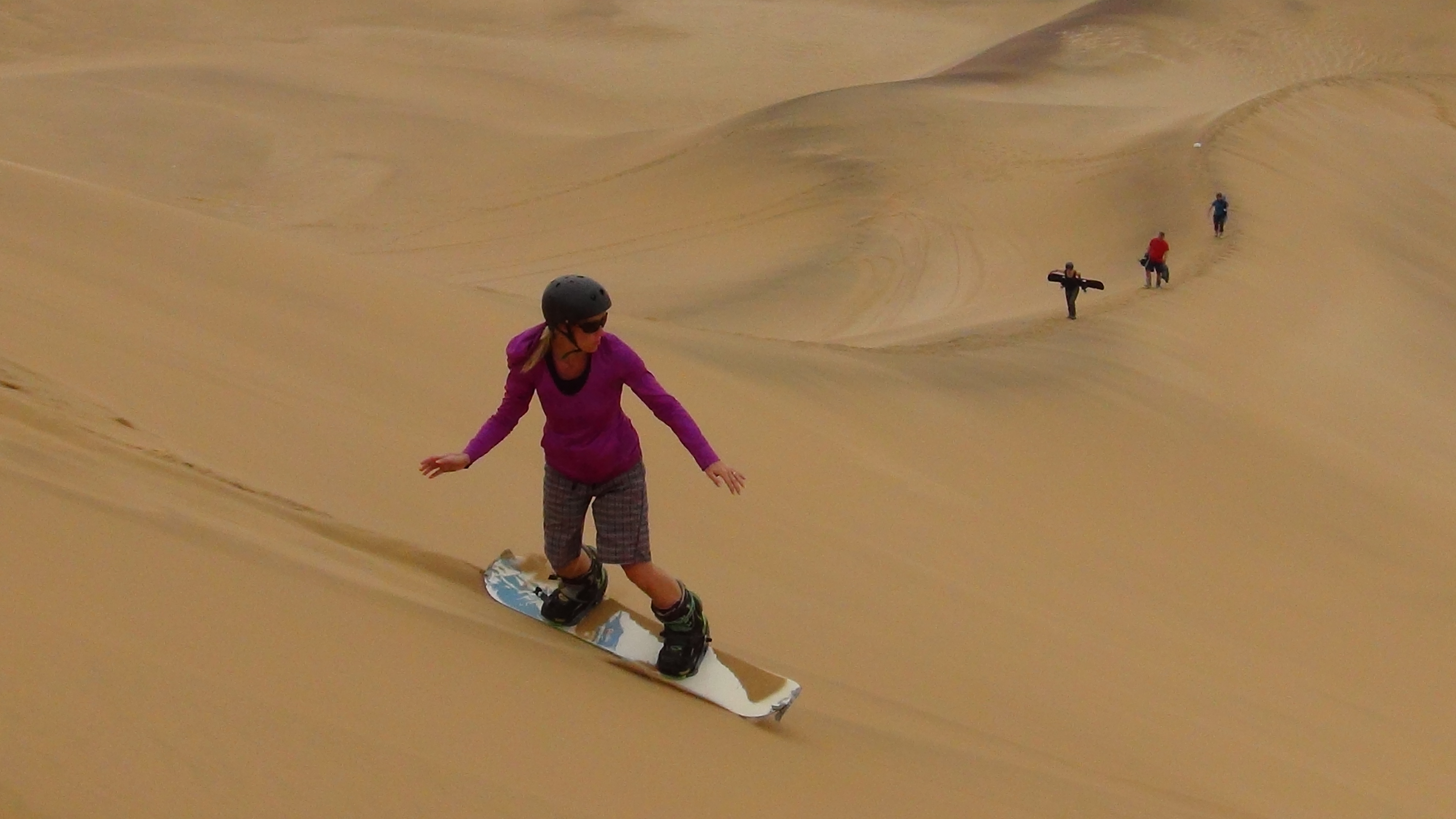
Sandboarding in the Namib Desert
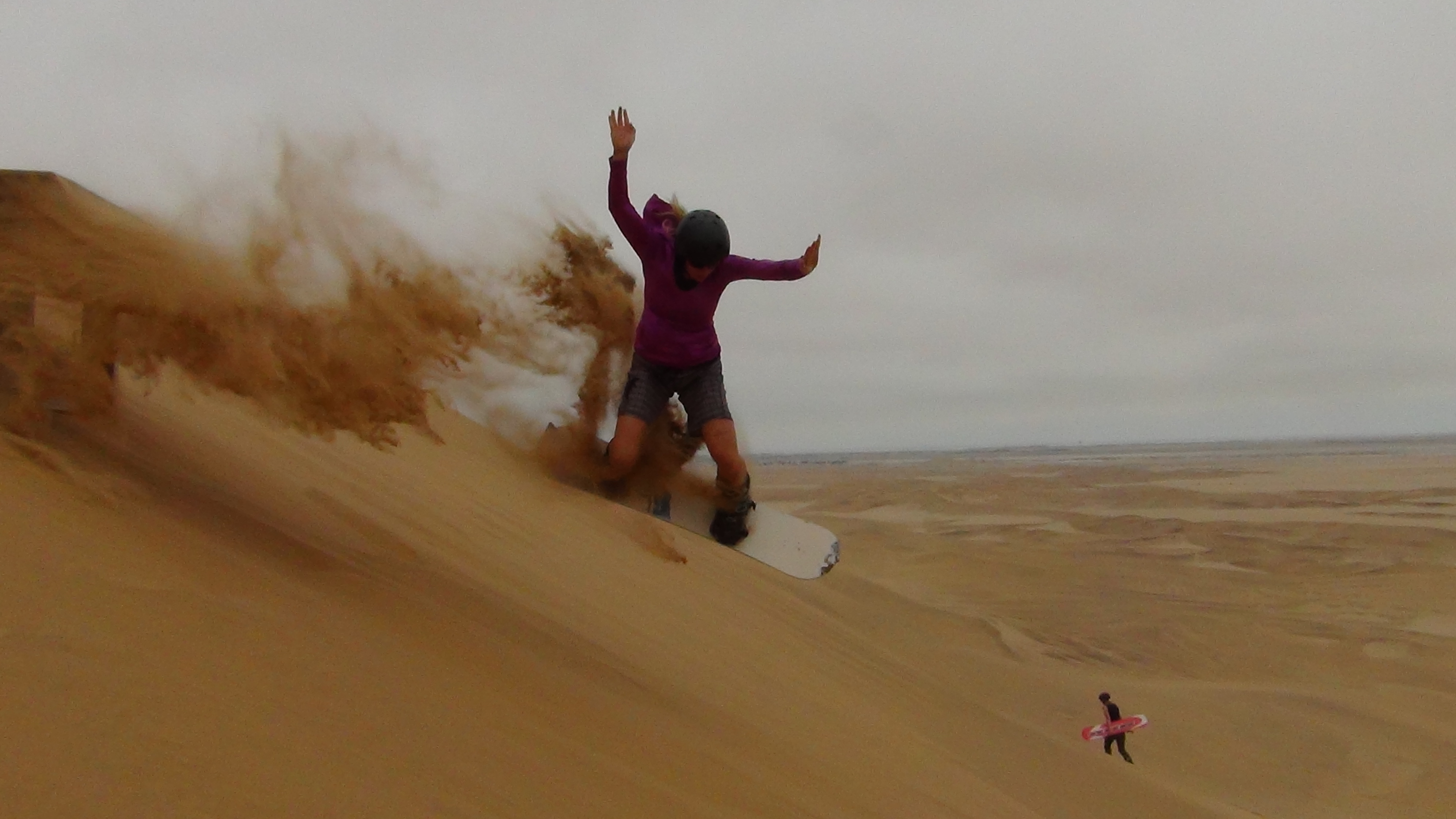
Sandboarding in the Namib Desert

IMG_3438

Landed the jump!

After riding the dunes for a bit and trying our luck with the jump we switched to BellyBoarding. Basically BellyBoarding requires that you climb to the top of a sand dune, lay on your stomach on a flexible piece of wood, lift the front corners up and slide head first down the dune. This was essentially EXTREME tobogganing because you end up reaching speeds of 78 km/h (they have a police speed gun to clock you in). It was a blast.

Tied for fastest of the day: 78 Km/h!

Tied for fastest of the day: 78 Km/h!

Following a lunch of SANDwhiches (no pun intended) we all hopped on Quad bikes. The 2 hours on the bikes took us ATVing through the desert up and down the dunes. When we got more comfortable we sped up and started doing rollers. Rollers involve opening up the throttle and gunning it up the sand dune then back down like a giant berm. Aside from a few people getting stuck in the sand and one girl hitting a rock and rolling off her ATV, we came out safe and sound. After this day I had sand in every crevice of my body! I found sand in places I did not know sand could exist.

The gang with our quad bikes.

The gang with our quad bikes.

The following morning we did a township tour where we were taken out of the clean, dream like tourist area and into the blocks where the locals lived. Some of the houses were nicer than others. Back when the Germans were colonizing Namibia they strategically gave the best housing to the minority black tribe and the worst housing to the majority black tribe that had previously been in power. There were a few other tribes that received mediocre housing. The Germans did this on purpose to create jealousy and strife between the tribes so they would concentrate on squabbling with each other instead of using their numbers to unite and rise up against the white people. These tribes still exist today and for the most part they govern themselves with an elected chief who we met after we ate some traditional cooked worms. There was also special housing for the mine workers. The miners who work in uranium get the nicest homes in repayment for the toll working in a uranium mine will take on their health.
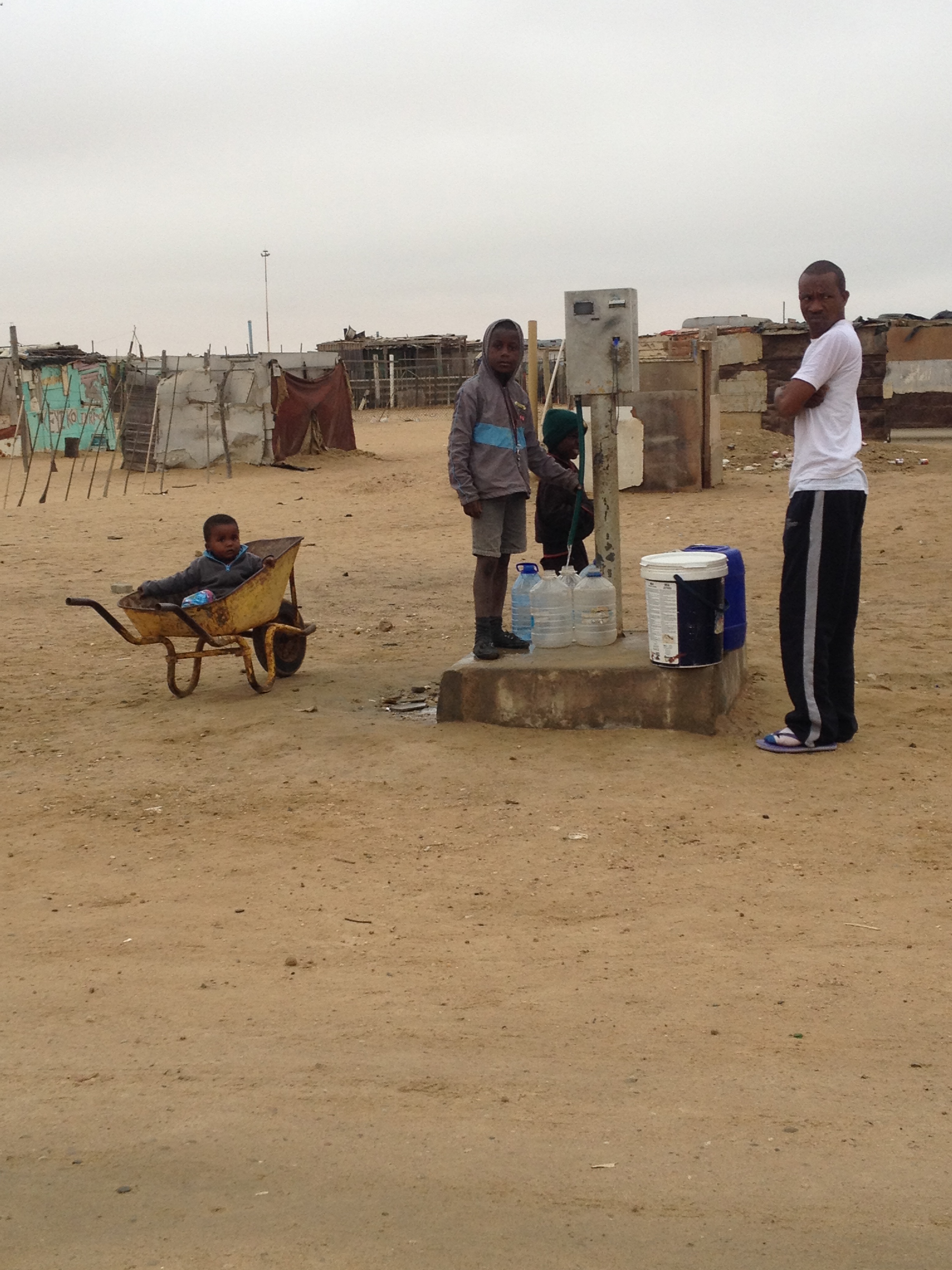
Locals in the poorest area paying for water.

Locals in the poorest area paying for water.

After saying our farewells to Swakopmund we hit the road again and headed to a farm in the middle of the desert. We passed an area called the Moonland (because it looks like the moon) and we also passed the Tropic of Capricorn which, as a Geography teacher, was a highlight for me.
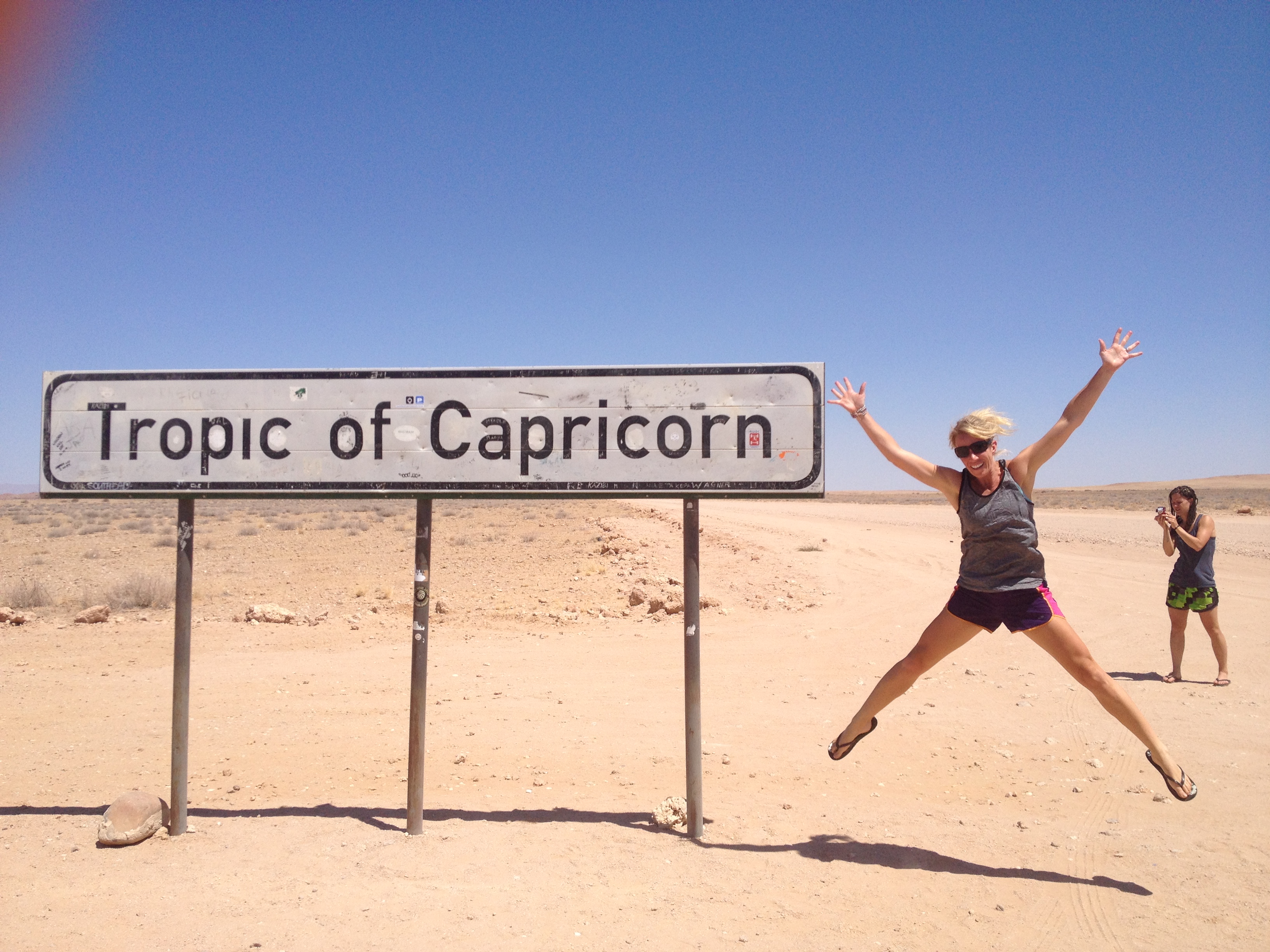
From the Tropic of Cancer, across the Equator, and down to the Tropic of Capricorn!

From the Tropic of Cancer, across the Equator, and down to the Tropic of Capricorn!

When we arrived at our Farmstay, we went for a tour around the giant farm to learn about the local vegetation and how to spot certain animals and insects. One of the most interesting insects was the trap door spider. This spider weaves a pile of web just under the sand and then digs a tunnel that can go down 120 cm into the ground. The spider waits in its tunnel until it feels the vibrations of its prey. When the time is right the spider will scurry up the tunnel, pop open the trap door, grab its prey and pull it back down the tunnel to devour.
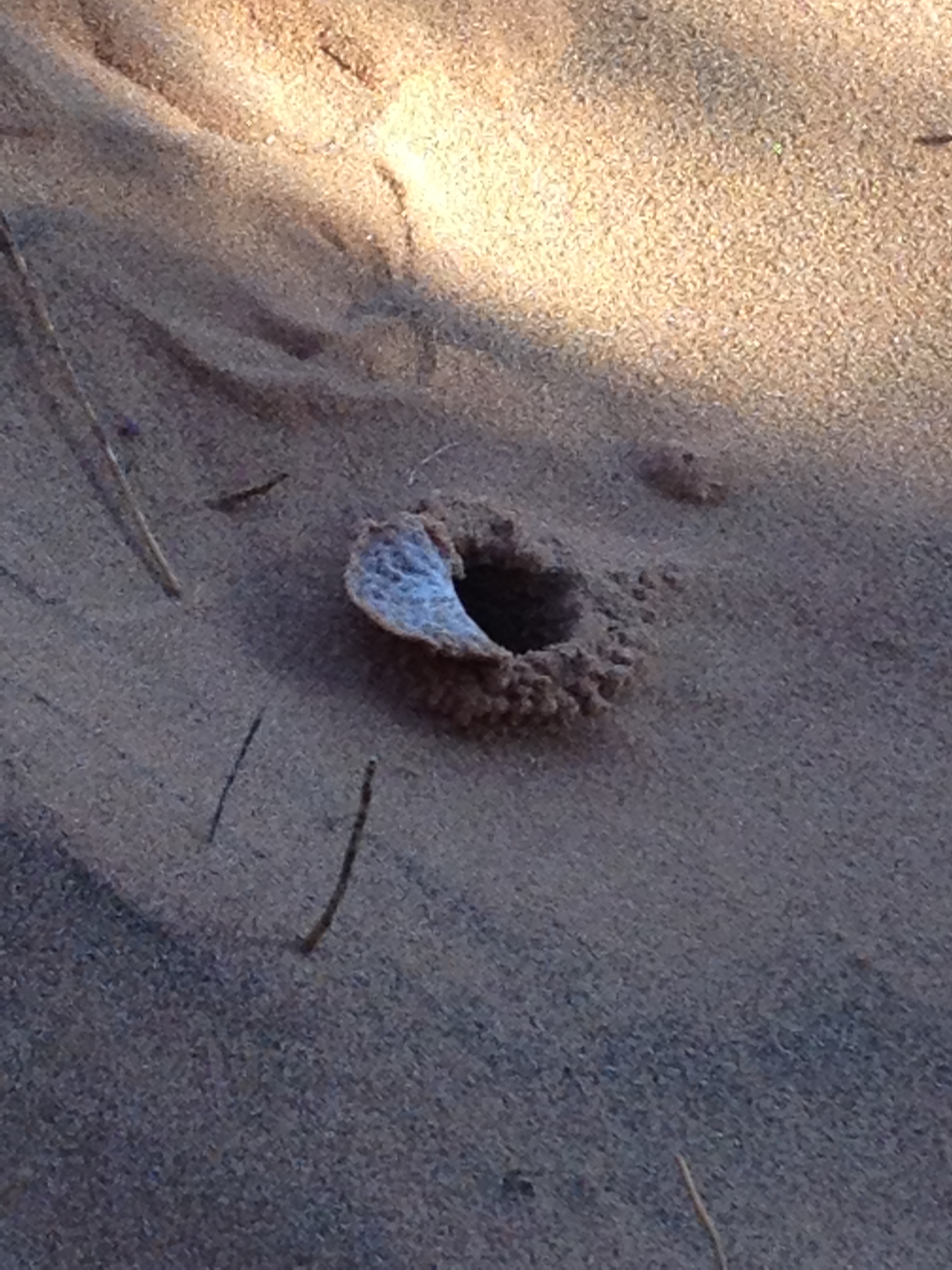
The Trap Door Spider's secret layer.  Muhahaha!

The Trap Door Spider’s secret layer. Muhahaha!

We ended our farm tour with a hike up a hardened sand dune to watch the sun set. It was absolutely stunning. What was even more striking was sleeping under the stars that night. There is something peacefully raw about sleeping outside with nothing between you and the surrounding wilderness. Due to our remote desert location there were no lights, no pollution, and few clouds. I didn’t know so many stars existed; it was overwhelmingly beautiful.
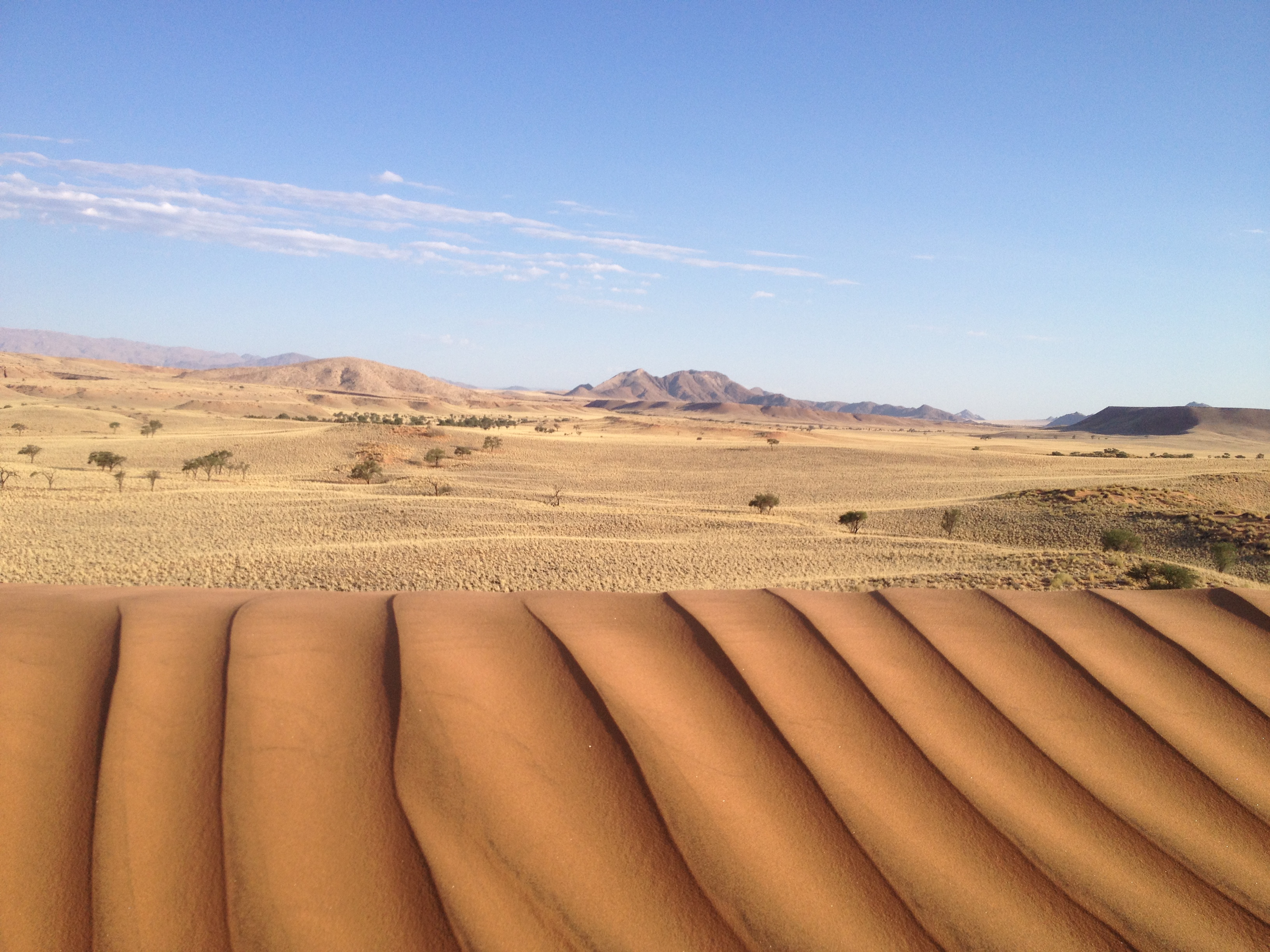
Imagine this was your farm?!

Imagine this was your farm?!

After surviving a night outside with no snake or scorpion bites we continued on to Sossusvlei. Following an afternoon of hiking through a canyon we rested up for a big surprise later that day. The big surprise was a visit to Fish River Canyon which is the second largest canyon in the world next to the Grand Canyon. Just like the Grand Canyon, the pictures do no properly show the beauty and depth of the enormous landscape. In typical African fashion there were no fences or warning signs anywhere at the canyon so we had to take care walking the kilometer long trail to the lookout point. To our delight our guides Colleen and Lucinda had prepared a wine and cheese tasting at the end of the hike for us. It was a lovely way to end the day.
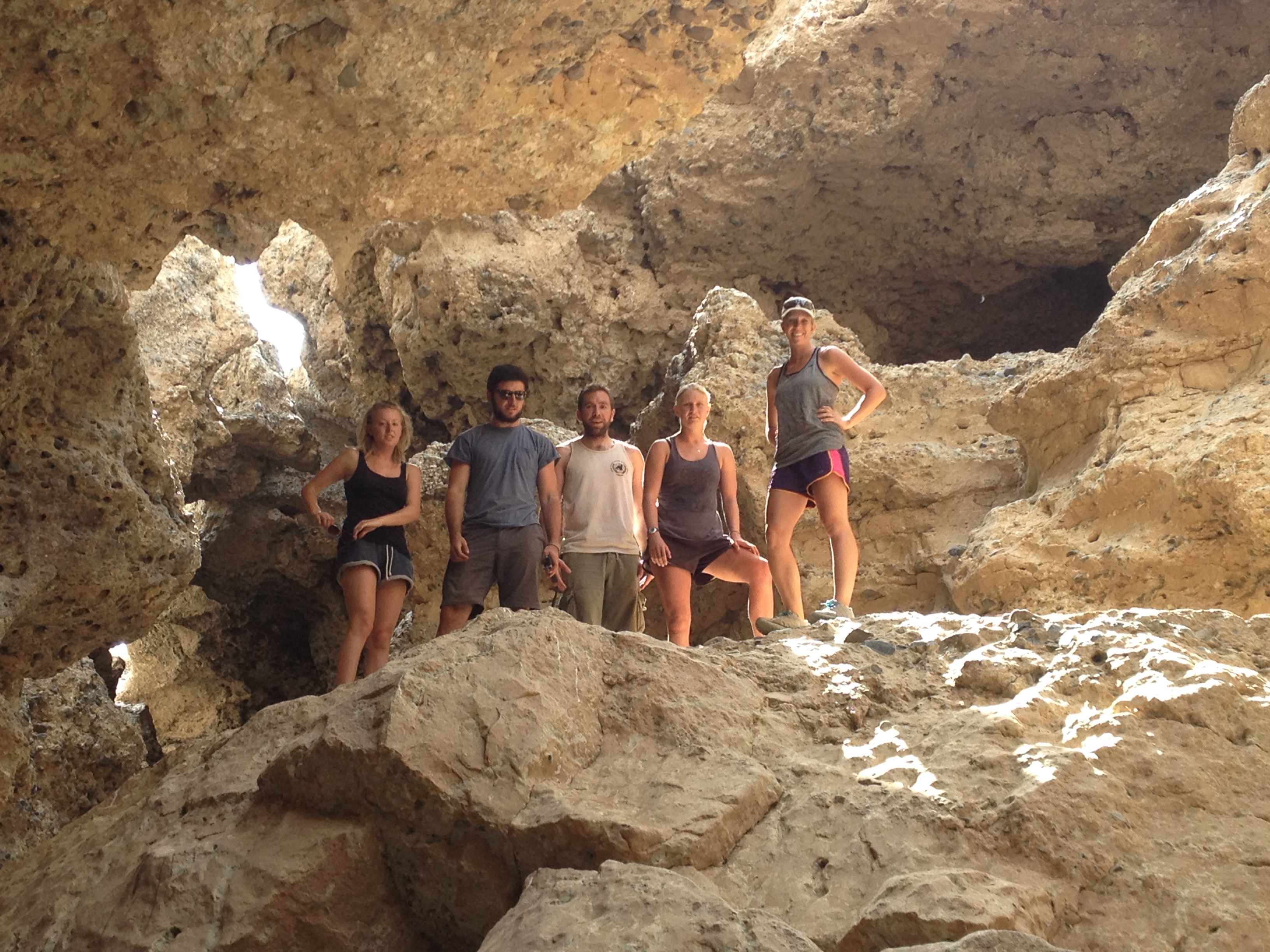
Hiking through a canyon.

Hiking through a canyon.

Fish River Canyon - 160 km long, 27 km wide, and 550 m deep.

Fish River Canyon – 160 km long, 27 km wide, and 550 m deep.

The next day we headed further into the Namib desert, the oldest desert in the world. You could tell it was the oldest desert in the world because the sand grains were so small. It felt like you were walking on icing sugar. The dunes are a glorious red colour because of the tiny bits of metal in the sand that oxidize and rust. Following some intense DangerBall in the pool we took a drive out to the dunes. We visited Big Daddy and Little Mama and the dried up Lake that used to exist before the shifting sand dunes cut it off from the water source.
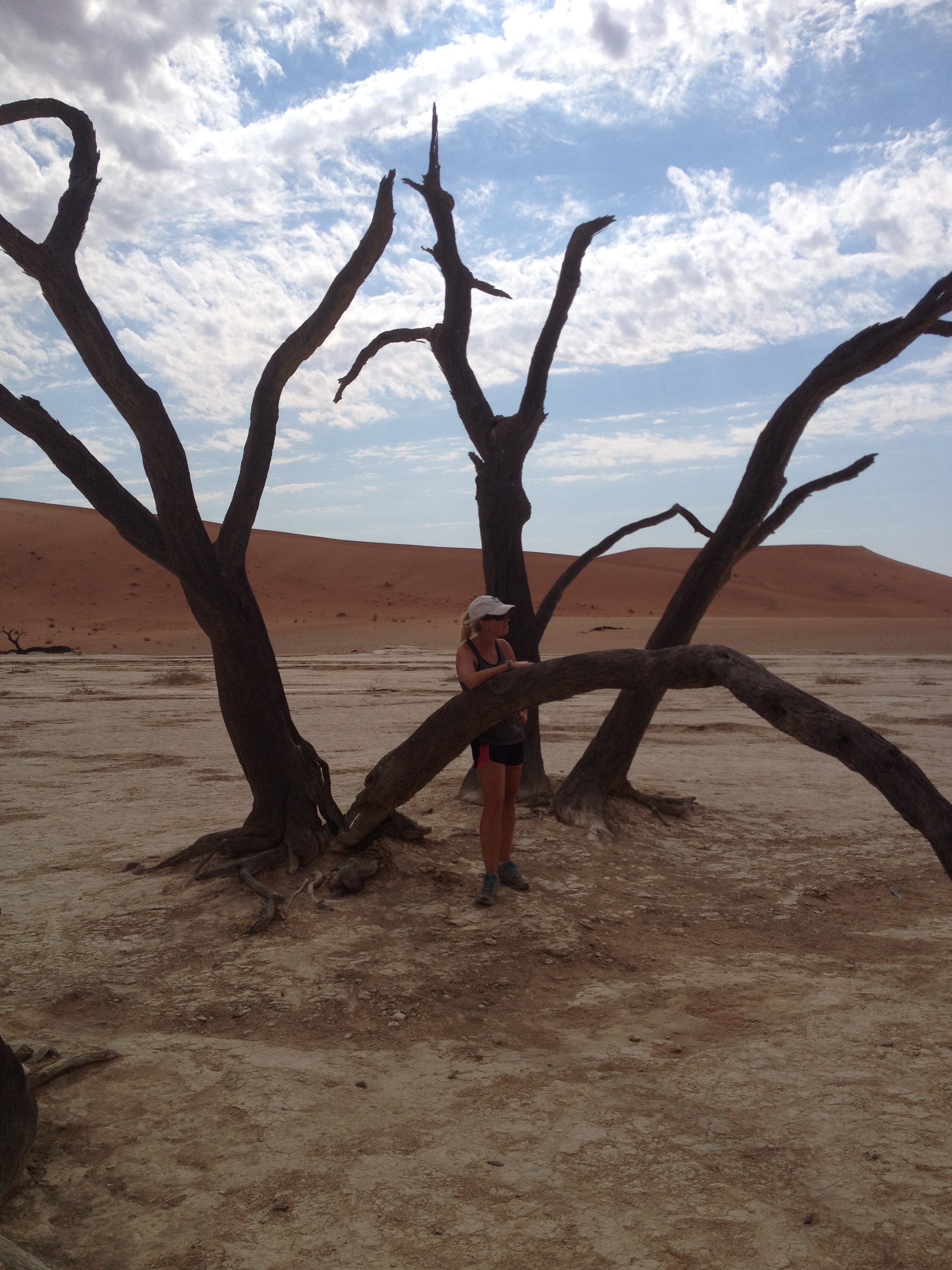
A dried up Lake in the middle of the desert.

A dried up Lake in the middle of the desert.

For sunset we made the trek up Dune 45, the most photographed sand dune in the world. If you’ve never climbed a sand dune I can tell you that it’s really hard work. Fortunately, sand dunes can only grow to a certain height because once the sand hits a 40 degree angle, it rolls down. At the top of Dune 45 we played Danger Dune (last one standing on the peak of the sand dune wins), somersaulted down the sand dune, made sand angels, and eventually watched the sun melt down over the horizon. After that we all used the momentum of the sand dune to run down at top speed. It was way easier going down than up! We fell asleep under the stunning view of the stars again that evening. Even though we had sand all over our bodies and grains infiltrating our sleeping bags, we were happy campers.

Feeling on top of the world at Dune 45!
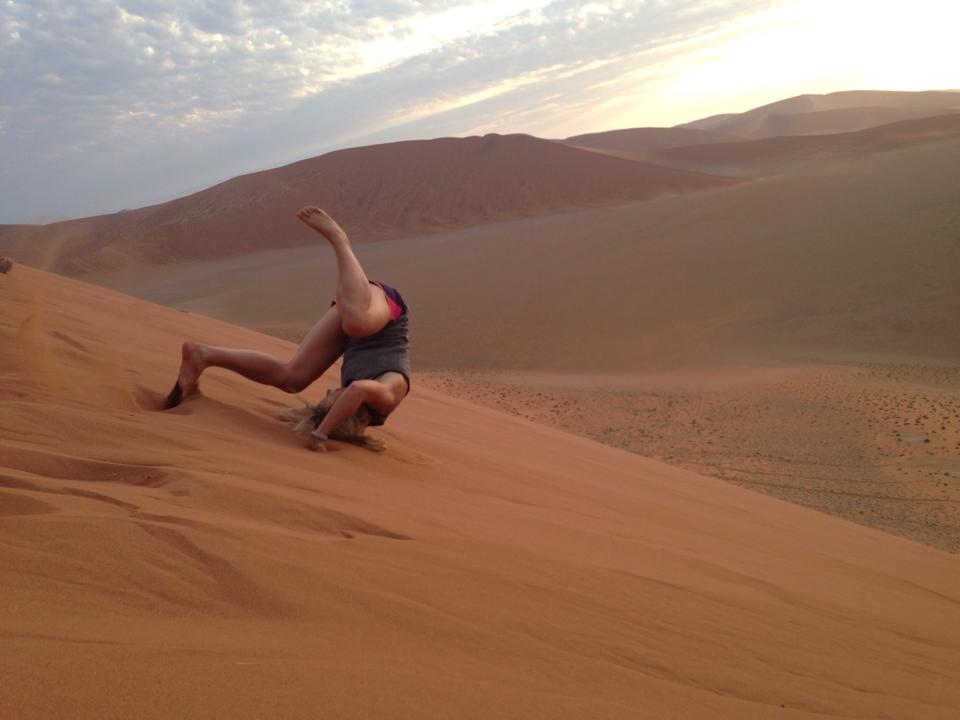
Feeling on top of the world at Dune 45!

"Danger-saulting!"

“Danger-saulting!”

The next day we crossed the border to our final country on the tour. Stay tuned for The High Class Hobo’s South African adventures!

Waking up to a sunrise over the sand dunes.

Waking up to a sunrise over the sand dunes.
Beautiful Botswana

My laptop is up and running again. Thanks goodness because all of my pictures that were on my camera (which is now at the bottom of the Zambezi River) are on my laptop.  The computer technician said that some of the wires had literally melted in the desert because it was so hot. It’s been a long time coming; with no further ado, I give you Beautiful Botswana!

To get into the country of Botswana we took a ferry across the Zambezi River at the point where Zambia, Zimbabwe, Angola, and Botswana meet After immigration we walked through a disinfectant and dipped the soles of our shoes in the liquid to prevent the spread of foot and mouth disease. At various points through Botswana we had to repeat this process and the truck-trolly had to drive through big puddles of disinfectant. One of Botswana’s major exports is beef so they need to ensure that the cattle stay healthy.

Pretending I'm on the Titanic.

Pretending I’m on the Titanic.

During our first night in Botswana we camped at Thebe River Safaris. We spent the afternoon dominating the pool (a trend that would continue throughout the trip) with extreme versions of childhood games such as 500 up and MarcoPolo. These were later to be known as “Danger” activities. This inside joke followed us throughout the entire trip. I love the people I’m traveling with, they’re hilarious! In the afternoon we went on a River Safari where we were welcome to bring a cooler of our own booze (Hobo win!). We saw many animals up close such as crocodiles, hippos, buffalo, elephants, and we ended the safari with a beautiful sunset over the water.

A Hippo going for a dip in the River.

A Hippo going for a dip in the River.

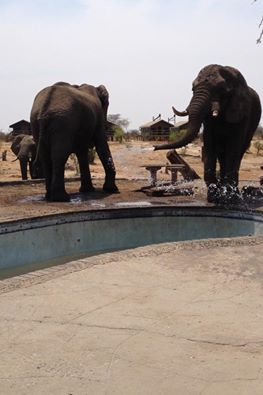
The next day, after a short drive we stopped for lunch at a place called Elephant Sands. It was named accurately because Luzinda (our driver) had to gun it to get us through the sand so we didn’t get stuck on the way in. We were doing well until an elephant blocked our path and refused to move. Eventually we got to the lunch spot where the elephants had taken over. There is usually a watering hole but it had dried up because the elephants smelled the water coming out of the pipe and they broke the pipe with their trunks. The dominant male elephant had claimed his spot at the swimming pool bathing and slurping up the last of the water that existed in the area.

Dominant Elephant hogging the last of the pool water

Dominant Elephant hogging the last of the pool water

After lunch we had a quick stop of the grocery store then we hit Planet Boabab. This camp was scattered with many Boabab or “upsidedown trees”. In the past people believed that God gave every animal a seed to plant. The hyena was given the Boabab seed and because hyenas are jerks they planted their seeds upsidedown, which is why it looks like the roots grow from the top of the tree. Planet Boabab is home to one of the oldest and biggest Boabab trees in the world. It is at least 1500 years old!

IMG_3040

Boabab Tree lit up at night

1,500 year old Boabab Tree!

1,500 year old Boabab Tree!

The following day we traveled to River Safari Campground. We were excited to find a pool again but when we went to jump in the staff told us it was being cleaned at the moment. Around 2:00 we asked again if we could go in the pool. The staff attendant leaned over the pool (I thought he was going to do a pH test) but instead he sniffed the water, took a taste, and told us it was good to go! That evening we took care of any business we had on the rare, free wifi and prepped for our outing into the Okavengo Delta.

The Okavengo Delta is a river that starts in the highlands of Angola (the country to the North) and travels down to Botswana where it splits into tributaries. Beyond the tributaries the water simply disappears and evaporates into the desert. This gives you an idea of how HOT it is here. There was one point where I peed on the side of the road and there was actually steam rising from the ground because my urine was so much cooler than the scorching dirt. Our trip into the Okavengo Delta was true bush camping. We took only what we needed and hopped aboard a boat which wound through the twisting tributary for an hour until we arrived at the Poleing Community.

The fastest poler in the community - Lee

The fastest poler in the community – Lee

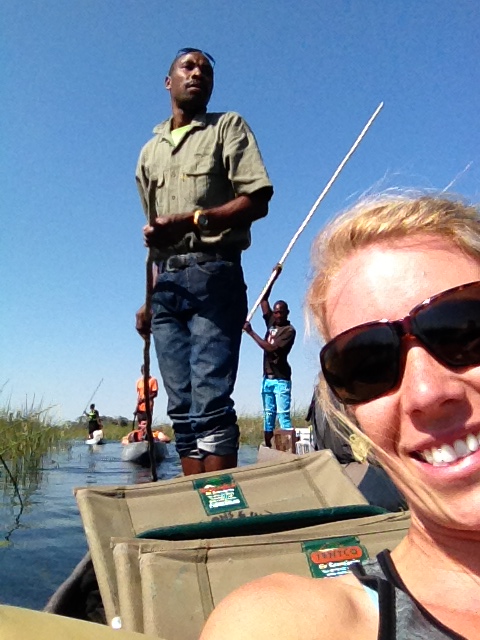
At the Poleing Community we transferred our items to Mokoros which are dugout logs that act as little boats. Each team got a “poler” and we set off weaving through the reeds as our poler used a giant stick to push the boat along. As you sit in the Mokoro you are pretty much even with the water level. You can’t make any sudden movements because the Mokoro will tip over. It was so much fun to wisp through the reeds and enjoy the gorgeous sunshine.

Gliding through the reeds

Gliding through the reeds

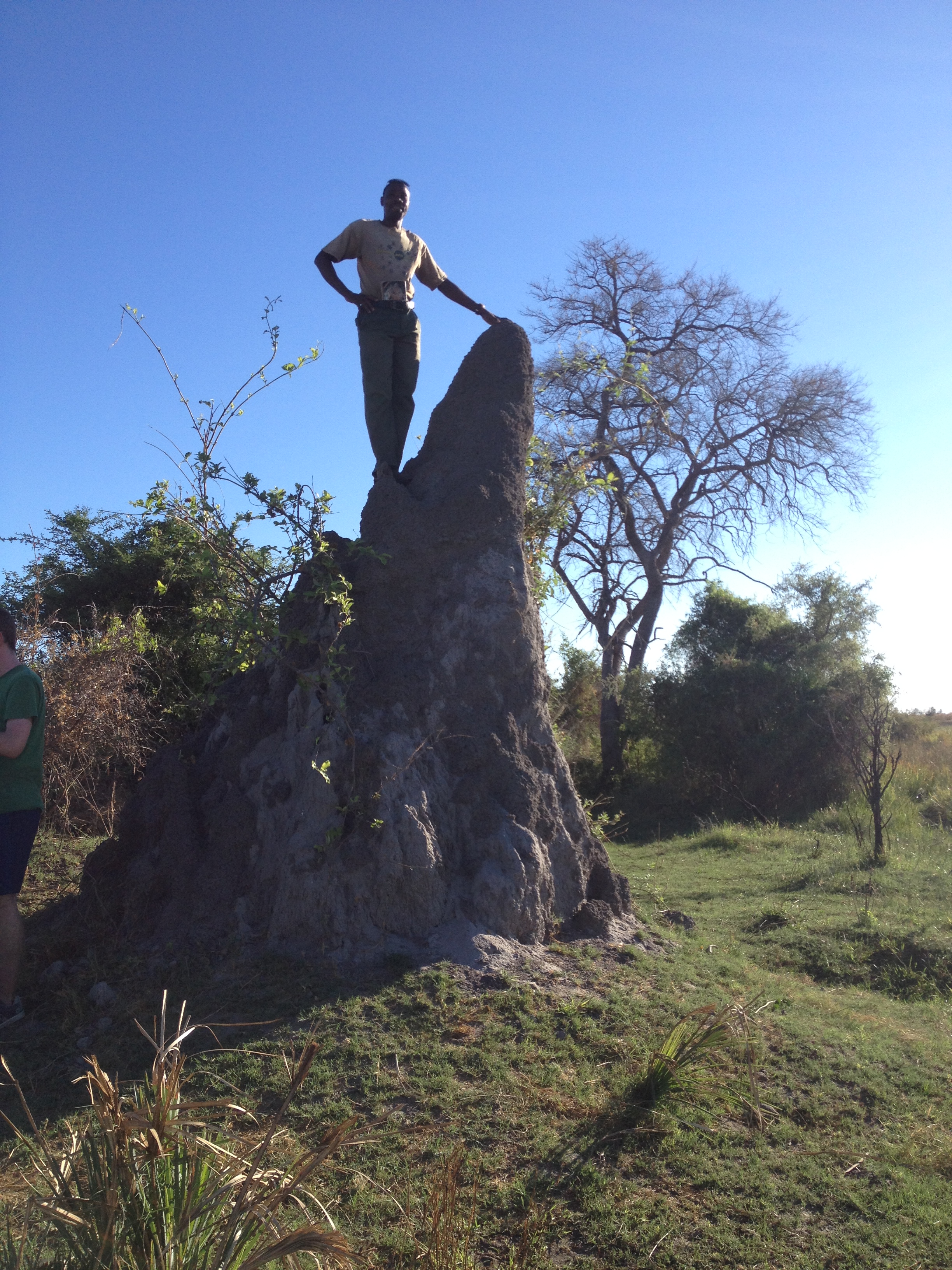
We reached our destination and set up camp. In the afternoon we swam in the crystal clear delta water and tried our luck at balancing and steering our own Mokoro. It was much harder than it looked! If you weren’t in the water that afternoon, you had to be in the shade. That day was the most intense heat I’ve ever felt in my life; I drank 5 litres of water and still felt dehydrated. Once it “cooled off” around 4:00 we took the Mokoros down the Delta so we could go on a walking safari. We had to wear pants so we didn’t get spiked by the thorny vegetation. We walked in silence for 2 hours and saw a Tsessepe which is a rare antelope that can run up to 70 km an hour. We also saw some giraffes running (they are so awkward with their gawky, long legs), a hyena nest, and a giant termite mound.

Huge, rock hard termite mound.

Huge, rock hard termite mound.

Upon returning to our bush we got to sample a traditional Botswana meal which consisted of a hearty, thick beef and vegetable stew served over milliepop which is like a thick porridge-mashed potato mush made of ground maize. Since it was a traditional African meal, it had to be served like a traditional meal. Each girl in our group had to pick a boy to serve. We were expected to know the proportions that our man would want and then had to serve it to them while kneeling down in front of them. Only after all the males were served could the females go help themselves to dinner. We spent the evening around the campfire listening to the locals sing traditional songs, dancing with them, and playing campfire games under the desert stars.

The shores of camp

The shores of camp

Upon our return to River Safari Campground the next day we all hopped into a much-needed shower and hit the road again. Our next stop was a secluded quarry campsite that we had all to ourselves. The old quarry was filled with a beautiful green water that was perfect for swimming. Later that evening we went for a walk with the San Bushmen. The San people talk in a click language so we had a translator. They took us through the shrub of the desert and taught us the medicinal use for certain roots they dug up. The San people are trying to keep their traditional way of life so they still dress in minimal animal skins and hunt and gather their food. The San people found giant caterpillars in cocoons for us to eat and they cooked them over a fire they started by rubbing two sticks together. To wash down their meal they drank water from a hollowed out ostrich egg that acted as their water bottle. The San people are SO resourceful and fascinating; it’s amazing how they survive.

Meeting the San Bushmen

Meeting the San Bushmen

Bushman water bottle

Bushman water bottle

Building a Fire

Building a Fire

Compared to the other African countries I have been to Botswana is very forward thinking. The tourism industry is based on “high quality, low impact” which basically means they jack the prices of tourism up so less people will come which leads to a healthier impact on the environment while still gaining financially. The President of Botswana is the son of a previous president who was exiled from his own country for marrying a white woman. Now that the current president from the original family is back in power the national animal of Botswana is the black and white Zebra to represent the acceptance of interracial marriages and families.

The next day we crossed to border from Botswana into Namibia, but I’ll save that for another post. Ka-a-os (good-bye in Damara) for now!

We have raccoons that dig through our garbage.  Botswana has Pumbas.

We have raccoons that dig through our garbage. Botswana has Pumbas.