Tag Archives: G Adventures

Segregated South Africa

The South African border was one of the most lax ones we crossed. This was unexpected for me because they are one of the more developed African countries so I assumed their Ebola scanning would be more stringent. If you enter South Africa you require a yellow fever certificate but they did not even ask to see it. This is probably a good thing because one of the people in our group forgot his certificate. 

          On our first day of arrival we camped at Orange River which separates South Africa from Namibia. The afternoon was filled with floating in the water, getting a thrill out of “illegally” being in Namibia when we swam across the river, many games of Danger Flunky Ball, and a limbo contest. It was our last afternoon together and we made it a good one!
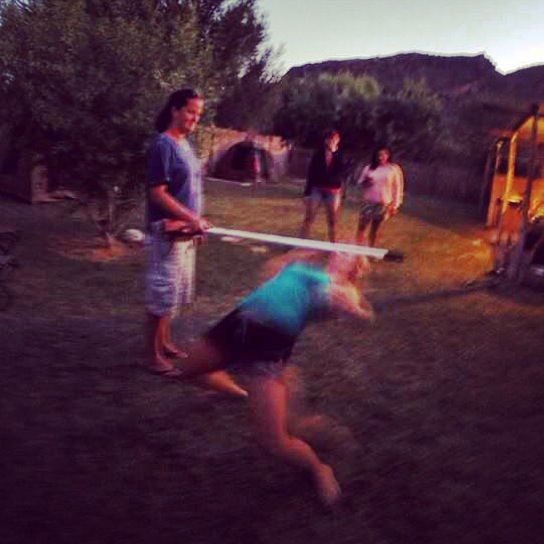
 

Campsite limbo contest

Campsite limbo contest

          For our next stop in South Africa we headed to the lush green landscape and the rolling hills of wine country. We set up our tent for the last time in the middle of a vineyard. That evening for $7 we sat in on a South African wine and cheese tasting. I’m not normally a wine drinker but I made an exception for the tastebud- tingling South African wine. The wine expert taught us how to look at the wine, swirl it for smell, and how to drink the wine while sucking air into your mouth to maximize the taste experience.

Delicious South African wine.

Delicious South African wine.

The next day after packing up our beloved tent for the last time we headed straight to Capetown. Technically our tour ended here but most of the group ended up hanging around Capetown for a few days. In true hobo style I had not prebooked any accommodations or departure flights. Fortunately my awesome roommate, Ling, offered that I stay in her room for the next 4 days and a newly engaged British couple offered that I could fly with them to Johannesberg and stay with them for a night. You can always depend on the kindness of strangers! … except these people weren’t strangers anymore, I had known them for 40+ days.

40 days later we had the  tent set up down to an art!

40 days later we had the tent set up down to an art!

          The first thing we did when we got to Capetown was head to Table Mountain. A group of 10 of us made the hour and a half climb to the top. The views were stunning but it was like being on the stairmaster for 90 minutes straight. Table Mountain offered a fantastic view of the coast as well as a look into the bowl of the city. We took the 360 degree rotating cable car back down to the bottom. Following our hike we went for dinner where I had the meal deal of some delightful pasta with South African white wine for $5.50. Capetown is known for their fantastic variety of delectable food, and I liked the prices. We stayed up late that night to say goodbye to a chunk of the group that would be leaving the next day and to celebrate Shane (an ex-Irish-army guy) on officially becoming a civilian at midnight.
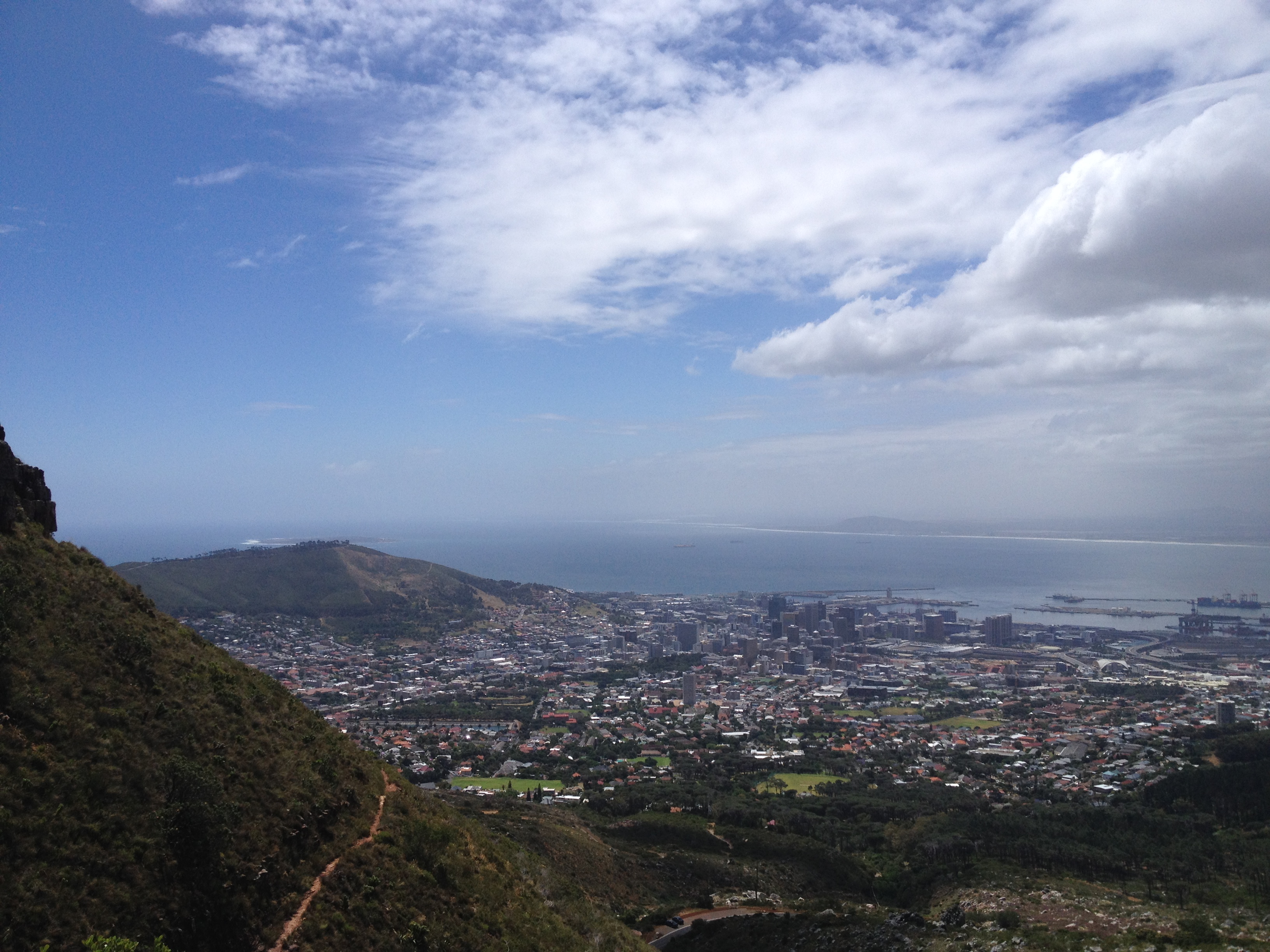
View of the city bowl on the way up Table Mountain.

View of the city bowl on the way up Table Mountain.

          The following day some of us took a tour down the twisting coastline of Capetown. First we took a boat out to see an island full of seals. I can see why Greenpeace gets mad about seal clubbing because they are really cute and super playful.
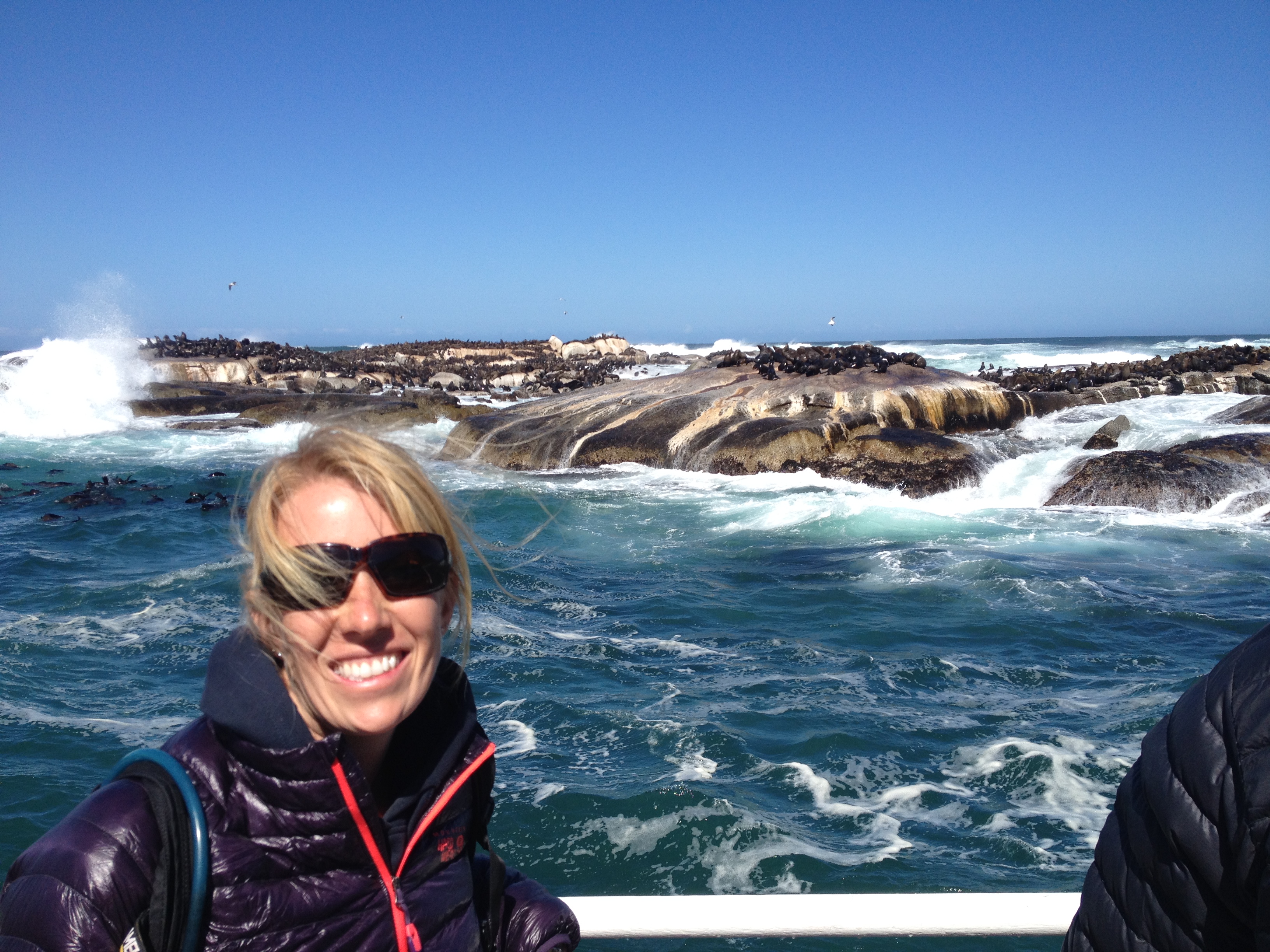
Laughing at the seals.

Laughing at the seals.

Next we continued onto Boulder Beach. Boulder Beach has lots of boulders (no surprise there) but it also has lots of penguins!

Adorable penguins at Boulder Beach

Adorable penguins at Boulder Beach

We continued onto the Cape of Hope National park where we had the chance to do some biking. Essentially you were just supposed to take a leisurely ride down the road until you reached the visitors centre where we would eat lunch. However, in true African style, the bikes they gave us were AWFUL! One girl fell off her bike and scraped up her face. As I was riding along my pedal fell off. I rode my bike like a scooter for awhile hoping I was not trespassing on baboon territory. Eventually the guide came along to replace my bike but the brakes were missing on my new one. Somehow we all made it to the visitor centre safe and sound except for one girl who was so bloody that she had to return to Capetown in a taxi.

Pedal in hand.

Pedal in hand.

Following the mayhem of the biking we visited a scenic lighthouse which is the spot where the Indian Ocean and the Atlantic Ocean meet. I was surprised by the number of tourists that were disappointed when they didn’t see a physical line separating the Oceans. This spot is also the most South Westerly point in Africa.

The point where the Atlantic and Indian Ocean meet.

The point where the Atlantic and Indian Ocean meet.

Our last stop was at the Cape of Good Hope but it was so windy that we couldn’t stay long and couldn’t climb the cliff without the probability of getting blown off.

IMG_3697

Day three of Capetown involved a much safer day of street strolling and shopping. I also used this day to do errands such as find a computer store to fix my laptop and I was lucky that Hubby Hobo’s parents offered to buy me a new camera as an early Christmas present. We wandered through the markets and down to the Harbour. The Harbour did not look like it belonged in Africa at all! In fact, it looked more like Pleasure Island at Disneyworld. It was clean, there were little shops and restaurants everywhere, live musical acts would pop up every now and again, and for the first time in two months I was not the minority. Our guide Colleen said that 30 million people visit the Harbour to go shopping every year which is more than the amount of people that visit the pyramids in Egypt!

IMG_3726

View of Table Mountain from the Harbour.

IMG_3724

I wanted to take the ferry out to Robben Island which is the prison where Nelson Mandela was held for years but the tickets were all sold out. I met up with friends for dinner and we called it an early night because we had to wake up at 5 in the morning for ….

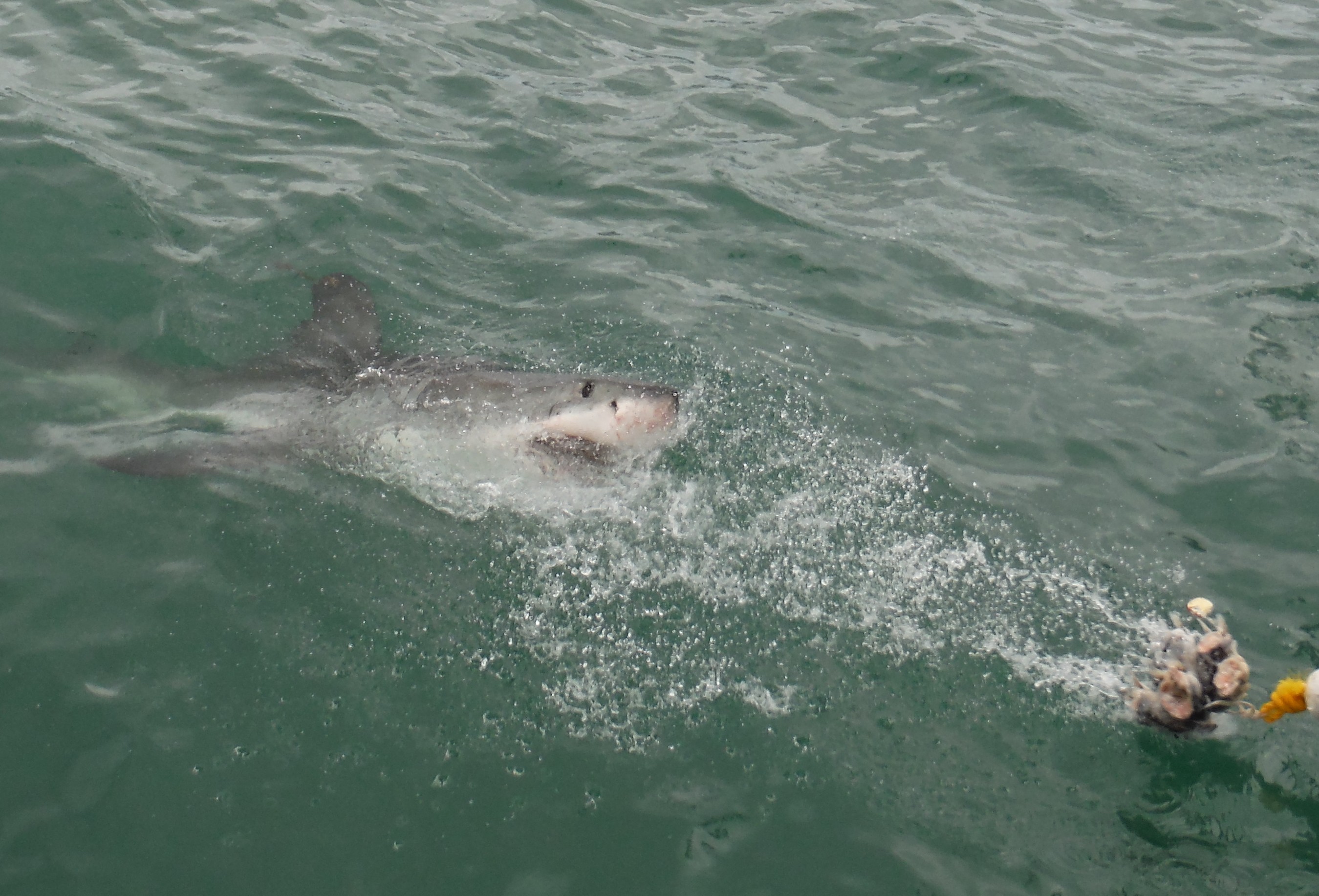
Shark Cage Diving! We chose to Shark Cage Dive with Marine Dynamics and I thought they were an extremely professional company. Upon they gave us a thorough safety debrief and a fabulous hot breakfast. We boarded the Slashfin (our boat) and started off into the Ocean. As the boat was driving we slowly released a mixture of chum, blood, and salt water into the Ocean so the sharks would pick up our scent and follow the boat. Once at our destination the first culprits climbed into the cage. One man held a line with a buoy and a bunch of chum attached to it and another man help a piece of wood painted black and in the shape of a seal fin. Together they would throw the “seal” and the chum out into the water to attract the sharks and lure them towards the cage. Unfortunately, we only saw a few sharks that day but we did see a lot of whales. If we had seen more sharks, the Shark Cage Dive day definitely had the potential to be one of the best days of my trip.

In the cage waiting for a shark.
In the cage waiting for a shark.

DSCF0012 (2)

A shark chasing the chum.

Pretending to be a shark.

Pretending to be a shark.

The following morning I ran downtown to pick up my laptop. It turns out that it did indeed melt in the desert so they replaced the wire that had melted. I shared a cab with Laura and Ben to the airport and we headed off for a night in Johannesburg. Johannesburg was the first spot in all of Africa where I did not feel comfortable. Someone tried to scam us while we were waiting for our pick up. When we made it to our hostel it was completely gated in. That evening we took a cab downtown (doors locked) to the Hard Rock Café. Laura collects Hard Rock glasses so it seemed like a good excuse to have some Western food. We took a cab back to the hostel as well …we took cabs everywhere.

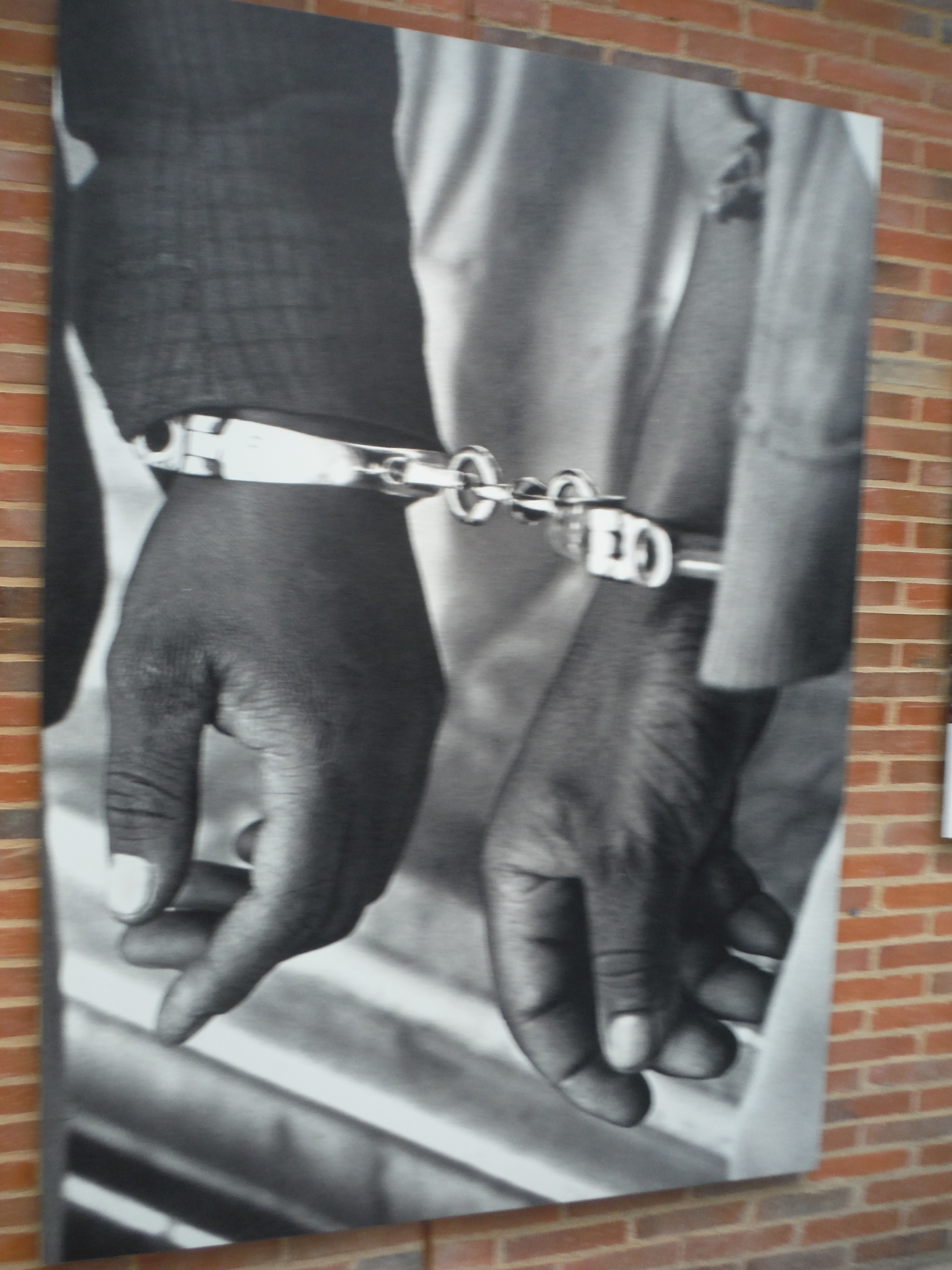
The following day I went to the Apartheid Museum. When I got there I sat on a rock for 90 minutes before the museum opened. Apparently the power hadn’t come on yet so they didn’t open the museum. TIA, I suppose (This Is Africa). The museum was worth the wait though. When I paid my fee to get in I was given a “white ticket” so I had to enter through the white door. Black visitors were given “black tickets.” I didn’t know much about the Apartheid before going to the museum so I will give you a quick summary of what I learned based on my visit.

DSCF0040

In the late 1800’s gold was discovered in Johannesburg. Many people came from the tribal villages to the city to work in the mines. During the great depression the price of gold went down. The owners of the mine still wanted to make a profit so they fired all the white workers (because they paid them the most) and cut all the black worker’s wages in half. Many black people refused to work for half the price so they imported Asian immigrants to work for the low wage. This was the introduction to the 4 categories of people that were segregated later on; the whites, the coloured, the asians, and the natives. As the rich got richer and the poor got poorer coloured and asians started moving into slums in Johannesburg. The white people feared that they would soon be outnumbered so they introduced a system of segregation. Everyone was given a certification labelling them into one of the four categories. The people in charge of labelling were unqualified white people. Some well to do coloured people who associated with white people were given white status and white people who worked with blacks could be demoted to coloured status. As the state of the slums got worse, the white politicians oppressed more. Asians, coloured, and natives could not vote. If the white politicians wanted the land that the slums were on they would displace all the people and destroy their homes. The minorities were given limited education so they would remain impoverished. Nelson Mandela spent 27 years as a prisoner for trying to lead a political party opposing the idea of apartheid.

Children trying to do their lessons on the floor in a crowded school.

Children trying to do their lessons on the floor in a crowded school.

Around 1990, the system of apartheid began to break down. Nelson Mandela was released and elected President in 1994. Many people died during the apartheid (mainly due to protesting) or were forced to work or live in horrendous conditions. I spent 3.5 hours in the museum but could have spent 5. It was incredibly fascinating.   It was obvious to me that this system of segregation had not totally broken down.  There were still huge slums outside of the city centres and it was obvious that white people were much wealthier. Upon speaking to people they admitted that the older generations are still extremely racist towards one another, but the younger generations are more accepting.   Hopefully the situation will improve as time passes.

DSCF0050 DSCF0043

Later that day I met up with Laura and Ben and we all continued onto Abu Dhabi. From there I said goodbye to the last of the group of friends I had met 45 days earlier.  I then hopped on a plane to Saigon, Vietnam. Goodbye Africa, Hello Asia!!!
Southern Namibia

We spent 9 days total in Namibia and it is one of my favourite countries so far. Namibia gained their independence in 1990 from South Africa. Namibia has a heavy German influence which makes for great food but a tough history. The colonization of Namibia was quite violent and up until the 1970’s the Native San Bushmen could be legally hunted like animals. It disgusted me that people used to make handbags out of the San women’s breasts but at that time they were considered non-humans.

San Woman and her cute San Baby

San Woman and her cute San Baby

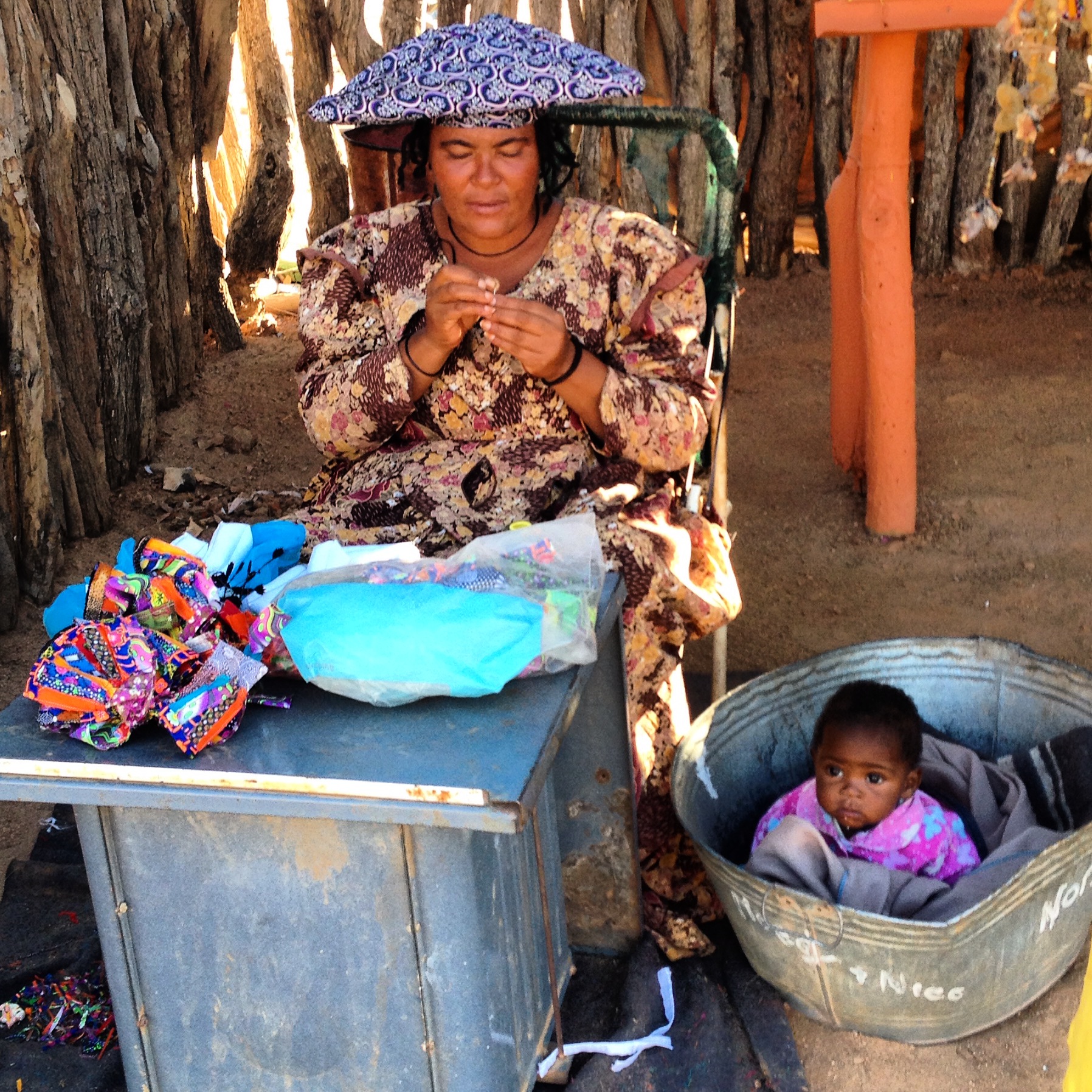
After the mountains of North Namibia we headed towards the South with Swakopmund being our desired destination. On the way we made a few stops. First we went to a Hierera market. Hierera people wear giant colourful dresses with huge hats of cloth that look like buffalo horns.

Hierra woman making crafts to sell.

Hierera woman making crafts to sell.

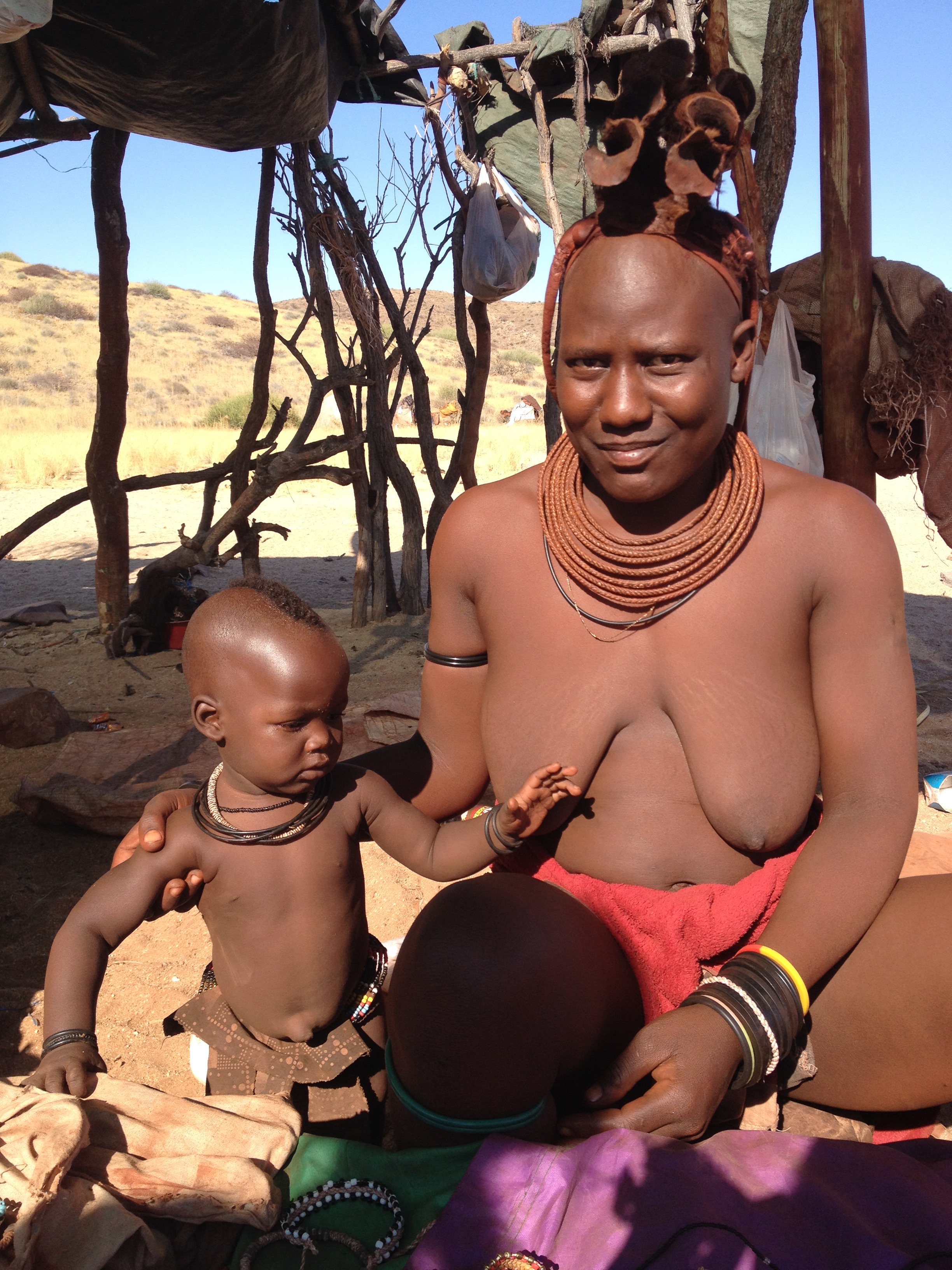
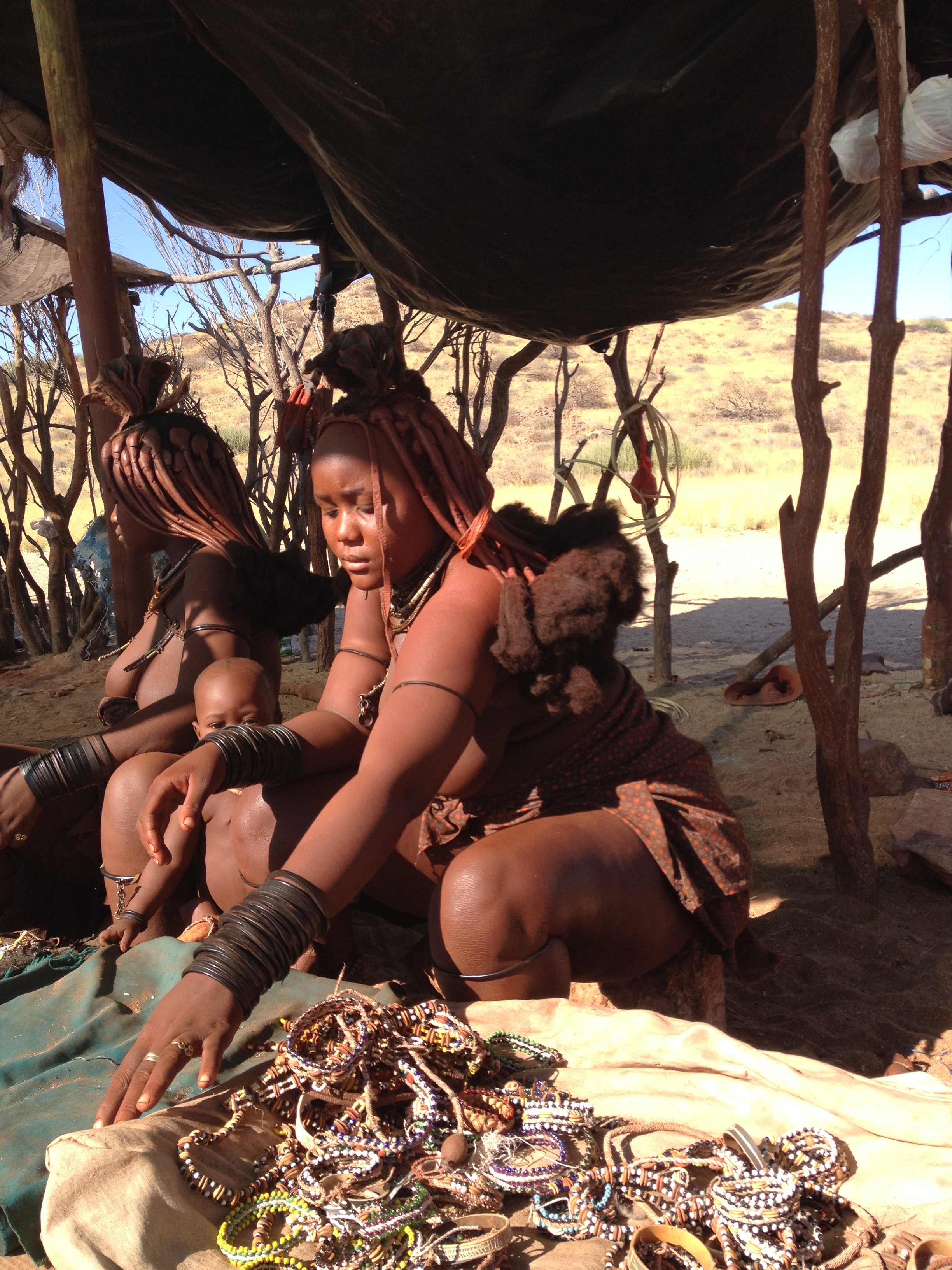
Next we stopped at a Himba market. The Himba people are one of the most photographed tribes in the world. After menstruation the women are not allowed to use water except to drink or cook. Every day the women wake up and perform an hour long ritual that involves rubbing animal fats, sweet smelling herbs, and bright orange mud all over their bodies to cleanse themselves. They also cake the mud onto their hair and leave giant puffs at the bottom of their dreads. They wear headdresses and loincloths made out of hunted animals. They are so exotic looking.

Himba woman.  The fur headdress means that she is married.

Himba woman. The fur headdress means that she is married.

Himba woman selling her crafts.

Himba woman selling her crafts.

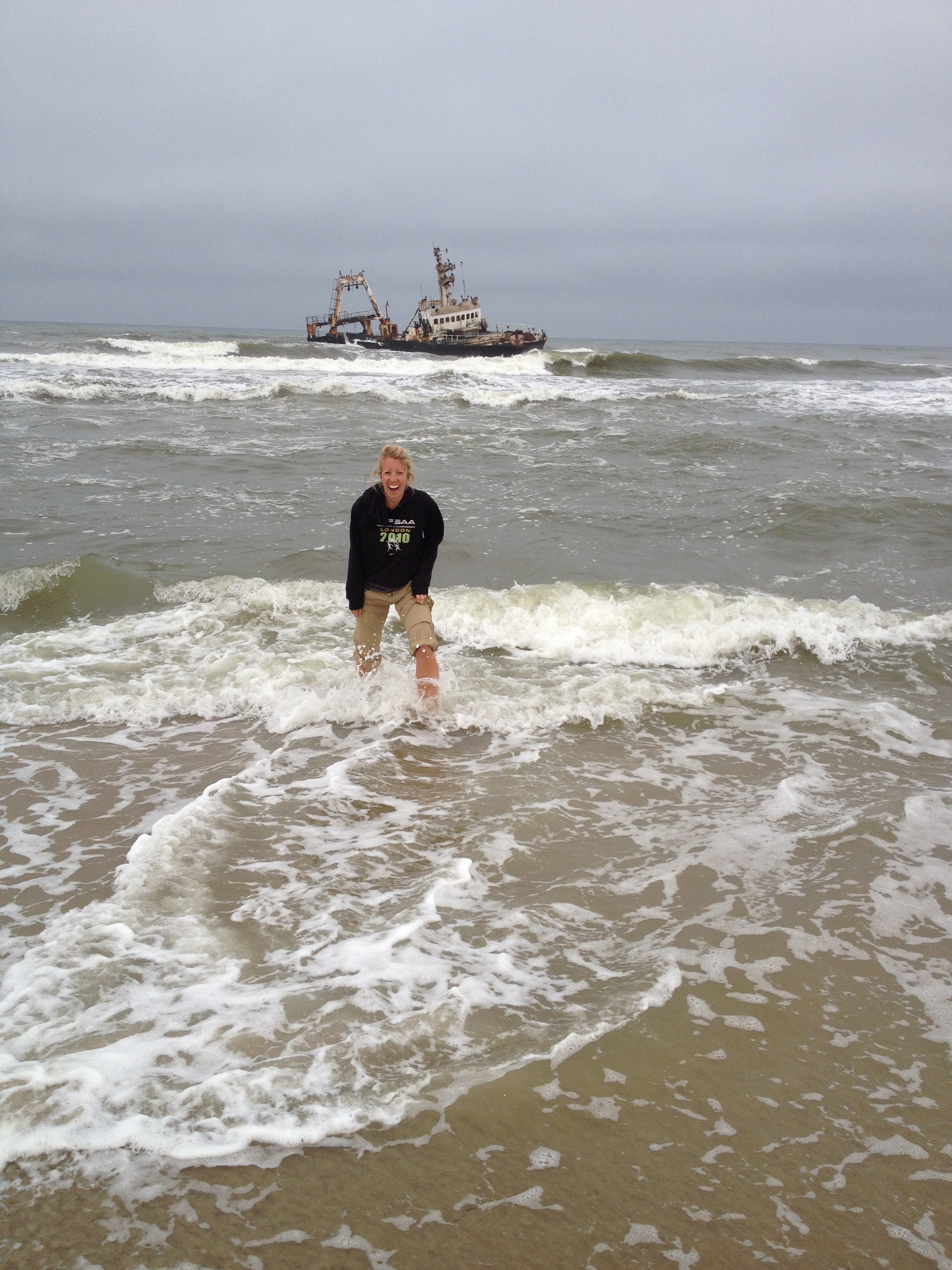
Our last stop on the road trip to Swakopmund was the Skeleton Coast beach. Our guides dared us to jump in the freezing Ocean coming directly from the Antarctica current near one of the many shipwrecks. The Skeleton Coast was given this name because once a crew shipwrecked here they were guaranteed to die because there was only desert for miles.

Yarrrgh Maties! It was cold!

Yarrrgh Maties! It was cold!

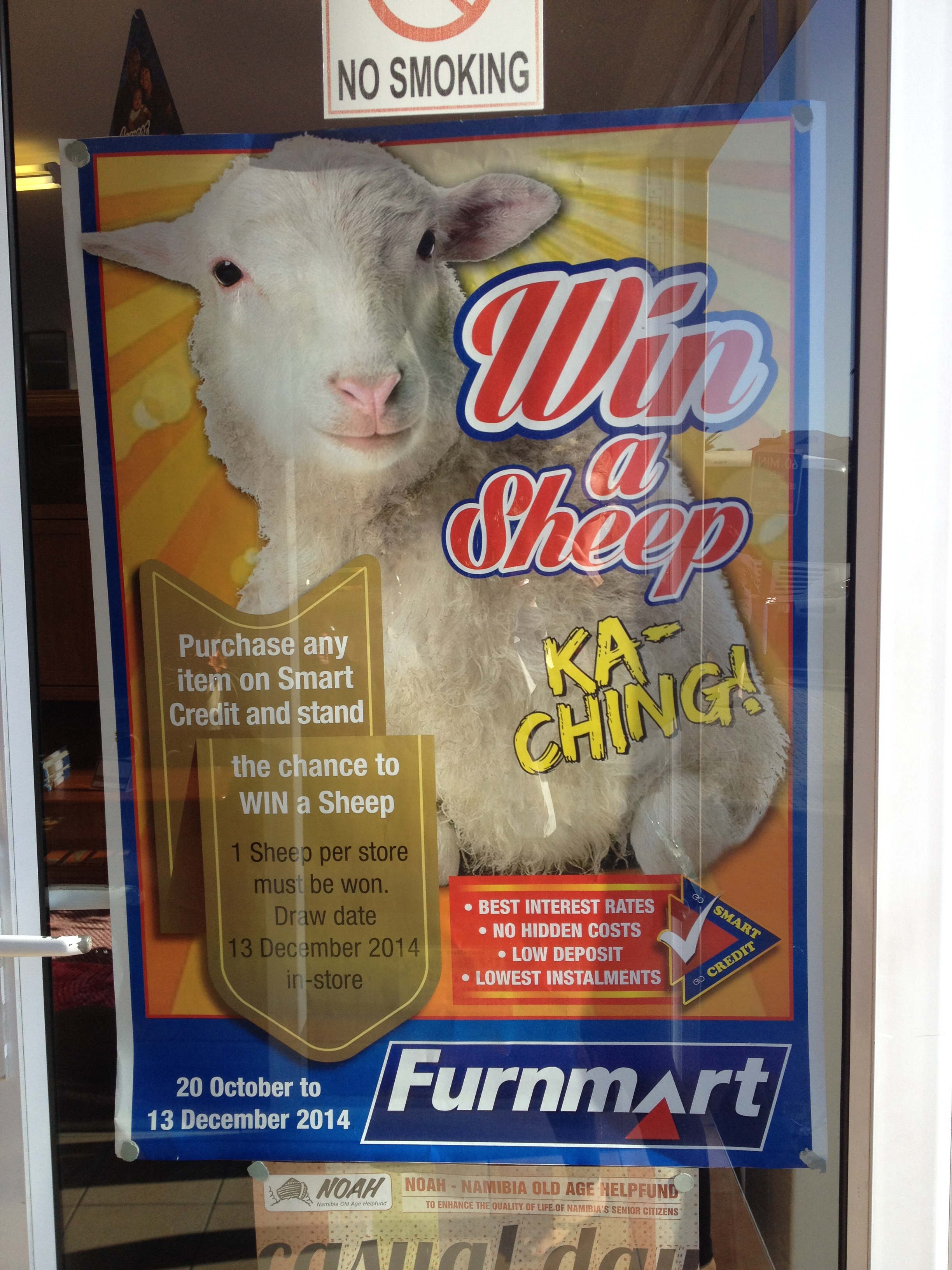
Alas we reached Swakopmund which looked like a completely different world! The only way I could tell I was still in Africa and not the outlet malls in Florida was the signs saying if you bought a couch you had the chance to win a free sheep! We ditched the tents for 2 nights and stayed in a giant dorm of bunk beds. Following an afternoon of shopping and wandering the streets we went out for a night of dinner and dancing. I cannot stress how weird it felt to be in such a “normal” environment again.

Win a free sheep!

Win a free sheep!

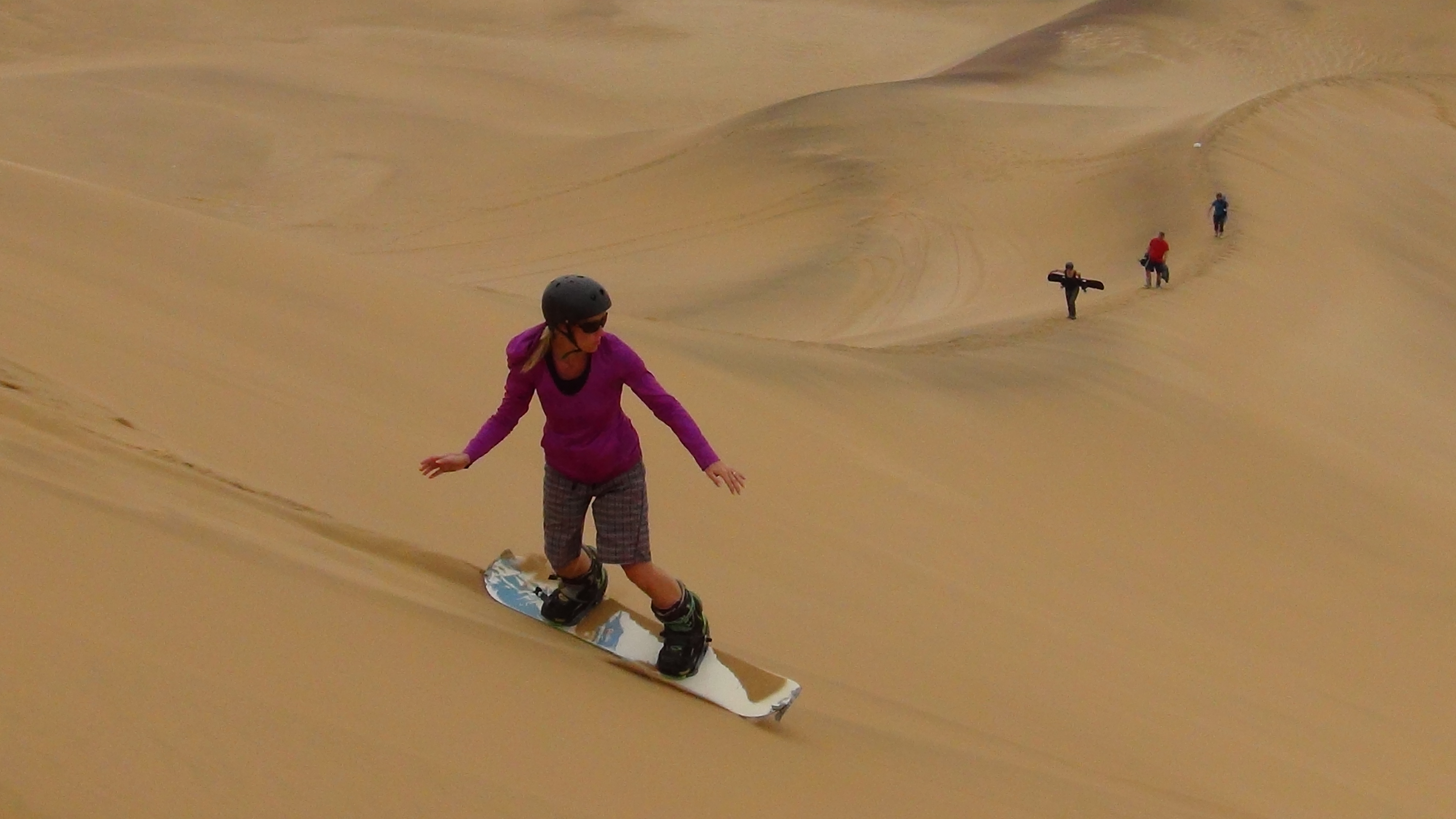
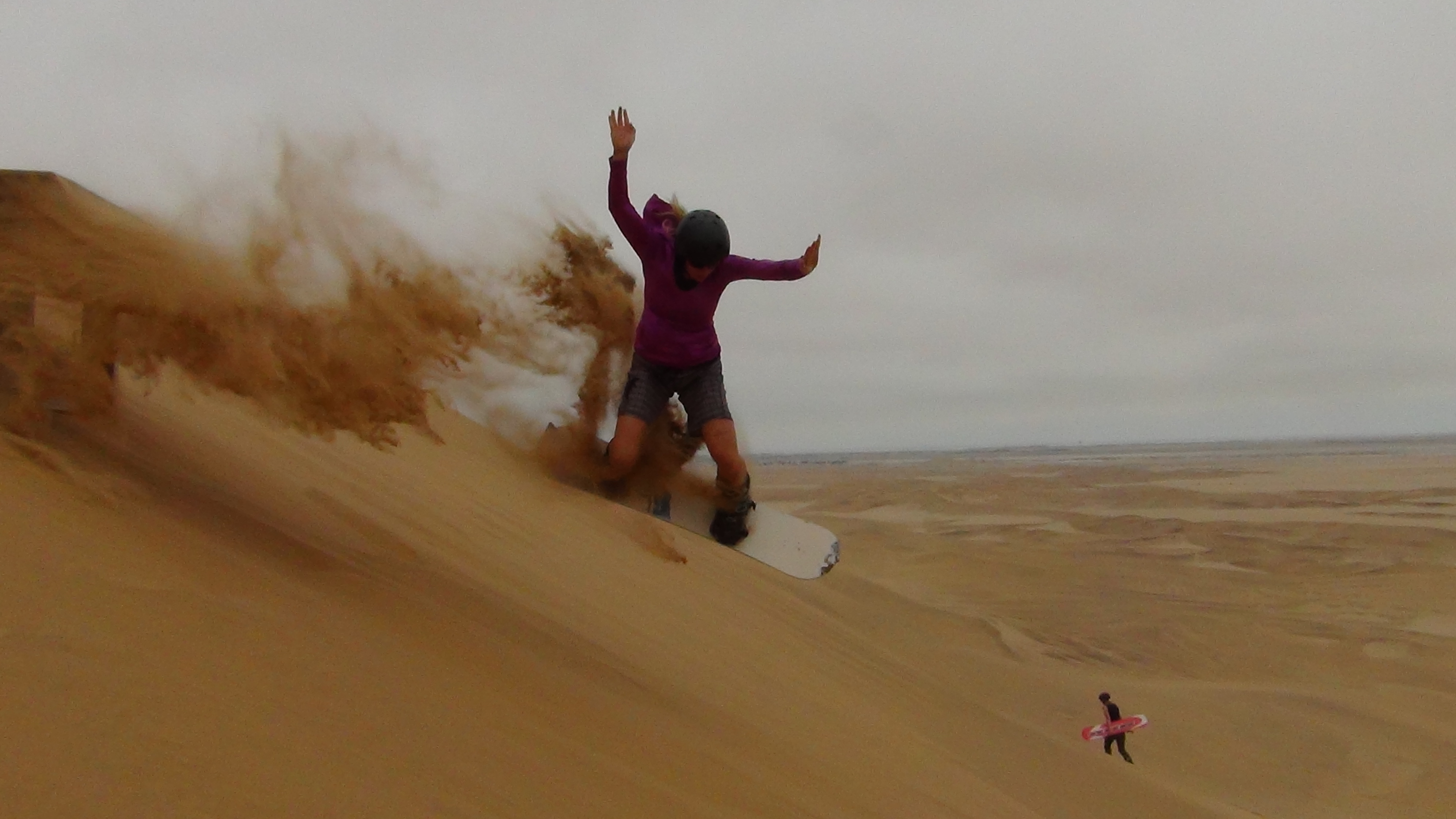
The following day was one of my favourite days of the journey so far. Sandboarding and Quadbiking!!! In the morning we were driven out to the giant star-shaped sand dunes of the Namib Desert. After climbing for what seemed like ages we reached the top with our modified snowboards. At the top we waxed the bottom of the board, clipped in, and set off down the dunes. It was SO much fun and very similar to snowboarding except I could do it in my shorts and sunglasses.

Sandboarding in the Namib Desert

Sandboarding in the Namib Desert

IMG_3438

Landed the jump!

After riding the dunes for a bit and trying our luck with the jump we switched to BellyBoarding. Basically BellyBoarding requires that you climb to the top of a sand dune, lay on your stomach on a flexible piece of wood, lift the front corners up and slide head first down the dune. This was essentially EXTREME tobogganing because you end up reaching speeds of 78 km/h (they have a police speed gun to clock you in). It was a blast.

Tied for fastest of the day: 78 Km/h!

Tied for fastest of the day: 78 Km/h!

Following a lunch of SANDwhiches (no pun intended) we all hopped on Quad bikes. The 2 hours on the bikes took us ATVing through the desert up and down the dunes. When we got more comfortable we sped up and started doing rollers. Rollers involve opening up the throttle and gunning it up the sand dune then back down like a giant berm. Aside from a few people getting stuck in the sand and one girl hitting a rock and rolling off her ATV, we came out safe and sound. After this day I had sand in every crevice of my body! I found sand in places I did not know sand could exist.

The gang with our quad bikes.

The gang with our quad bikes.

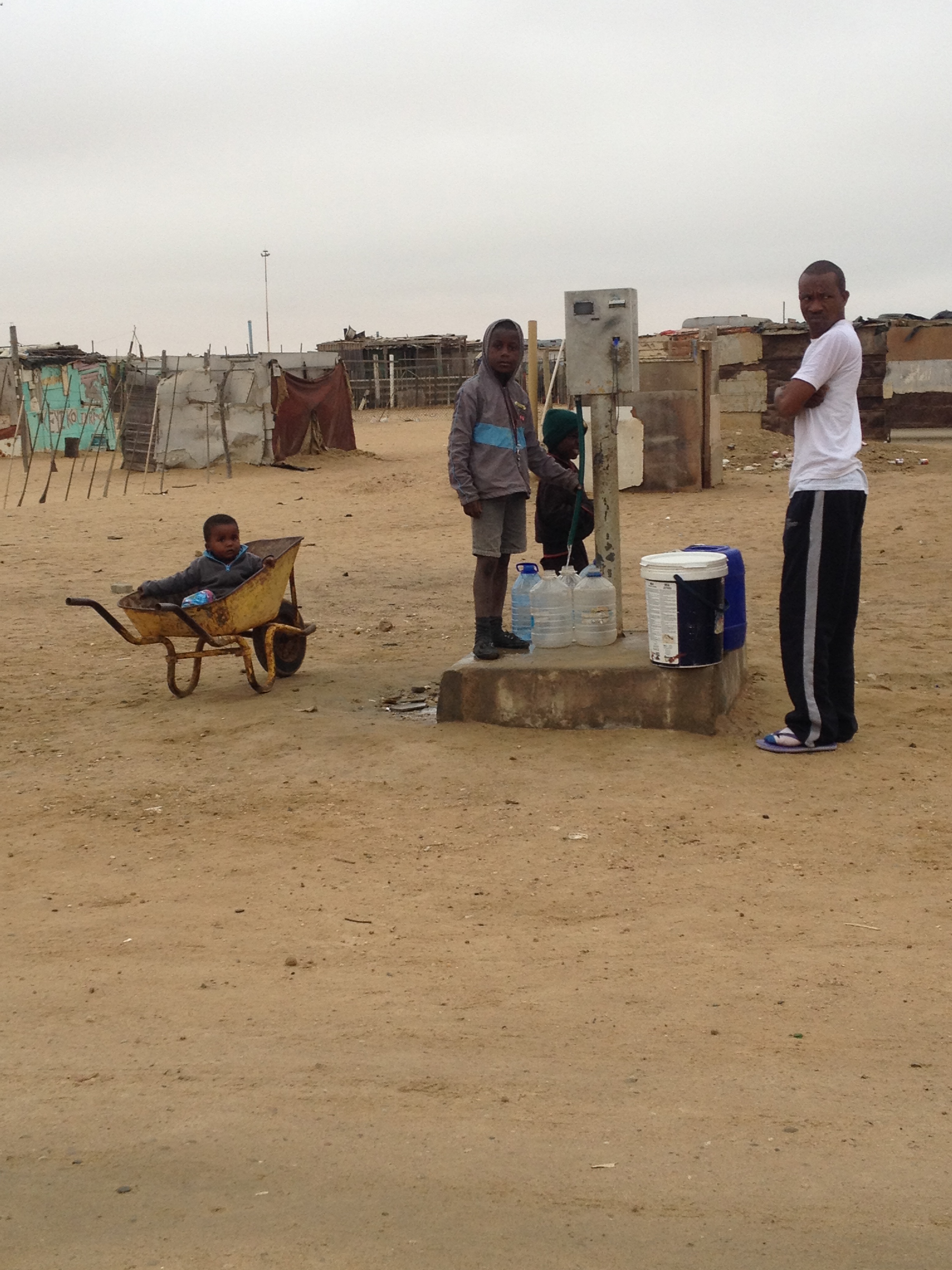
The following morning we did a township tour where we were taken out of the clean, dream like tourist area and into the blocks where the locals lived. Some of the houses were nicer than others. Back when the Germans were colonizing Namibia they strategically gave the best housing to the minority black tribe and the worst housing to the majority black tribe that had previously been in power. There were a few other tribes that received mediocre housing. The Germans did this on purpose to create jealousy and strife between the tribes so they would concentrate on squabbling with each other instead of using their numbers to unite and rise up against the white people. These tribes still exist today and for the most part they govern themselves with an elected chief who we met after we ate some traditional cooked worms. There was also special housing for the mine workers. The miners who work in uranium get the nicest homes in repayment for the toll working in a uranium mine will take on their health.

Locals in the poorest area paying for water.

Locals in the poorest area paying for water.

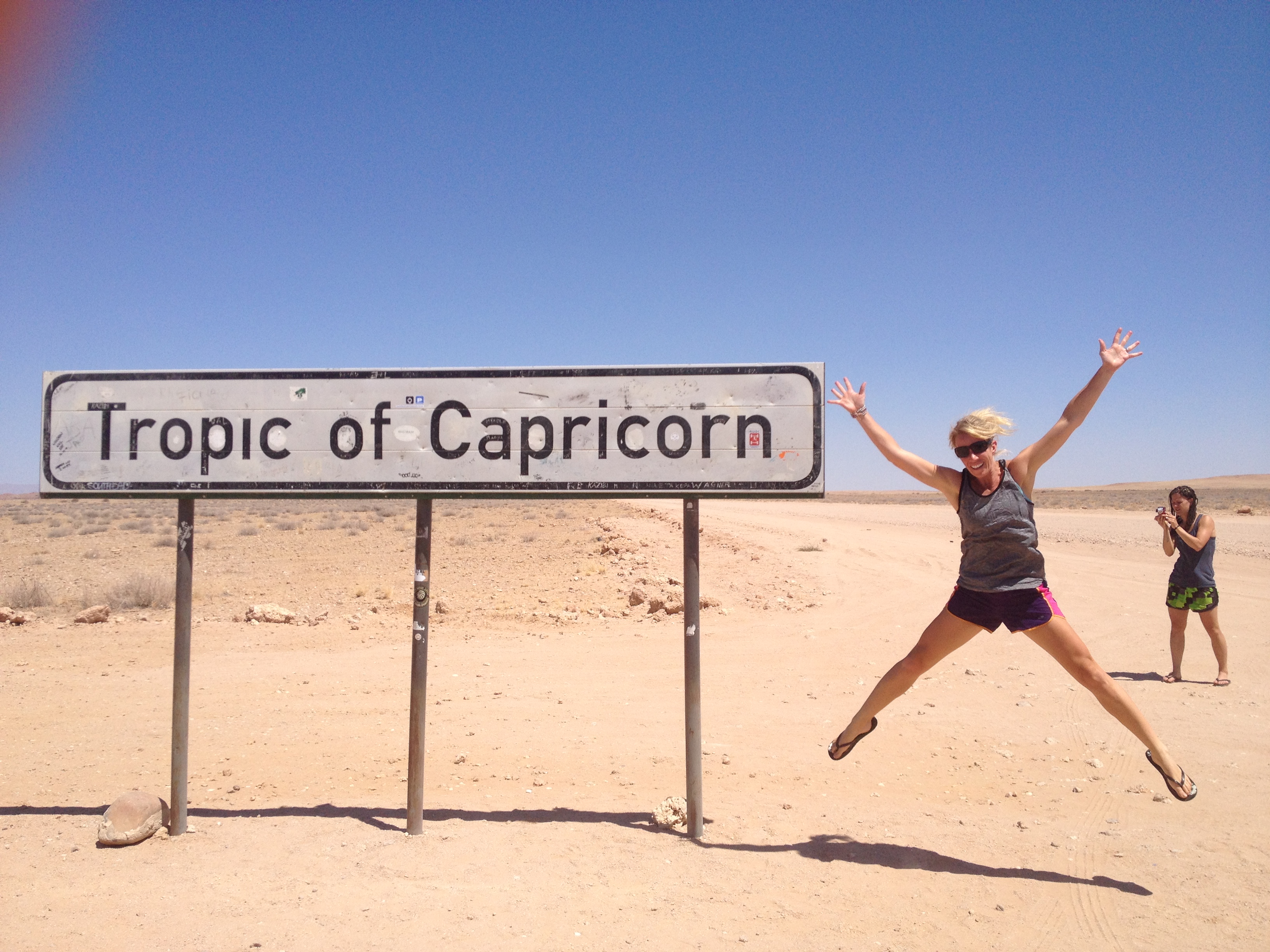
After saying our farewells to Swakopmund we hit the road again and headed to a farm in the middle of the desert. We passed an area called the Moonland (because it looks like the moon) and we also passed the Tropic of Capricorn which, as a Geography teacher, was a highlight for me.

From the Tropic of Cancer, across the Equator, and down to the Tropic of Capricorn!

From the Tropic of Cancer, across the Equator, and down to the Tropic of Capricorn!

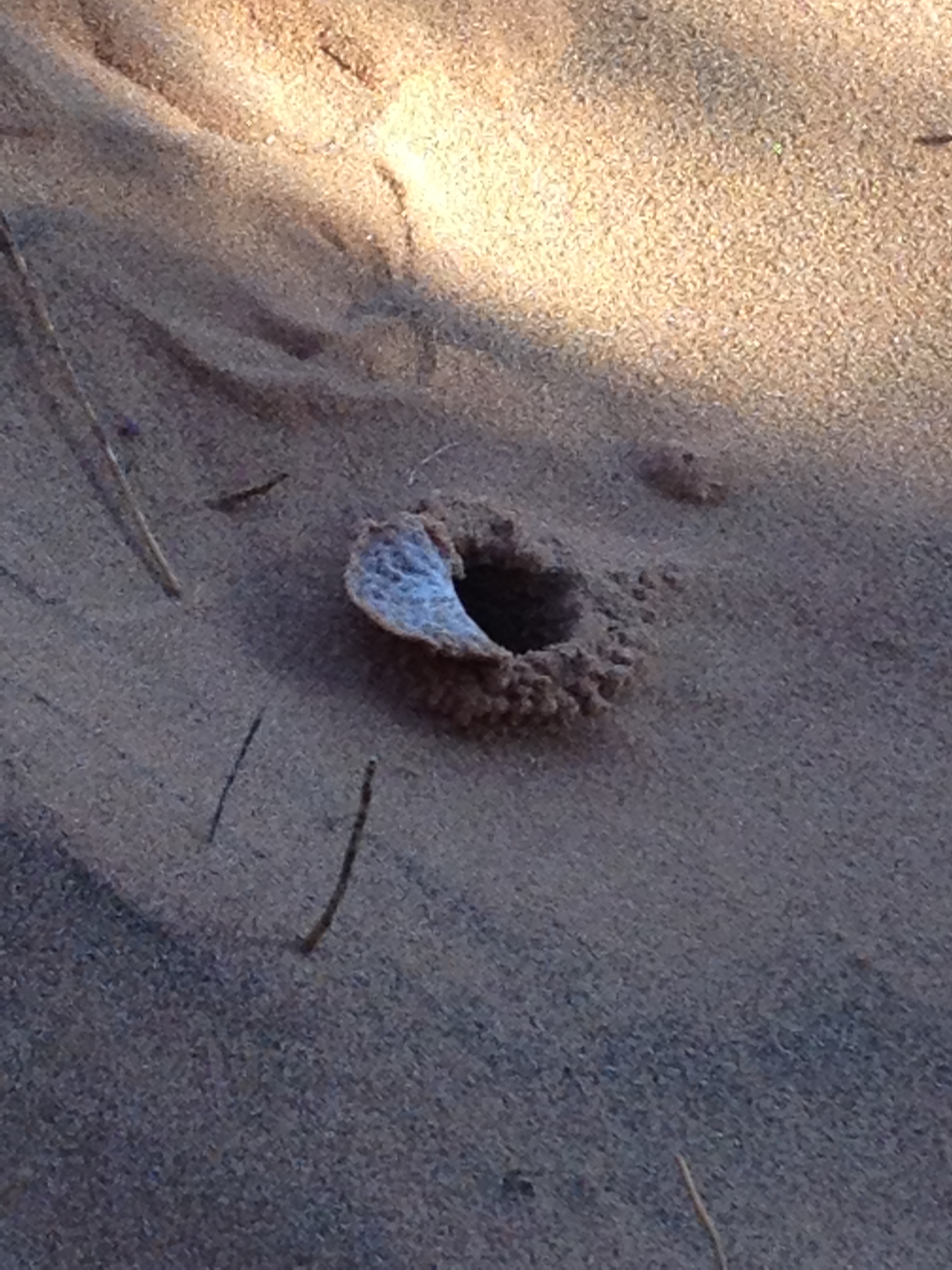
When we arrived at our Farmstay, we went for a tour around the giant farm to learn about the local vegetation and how to spot certain animals and insects. One of the most interesting insects was the trap door spider. This spider weaves a pile of web just under the sand and then digs a tunnel that can go down 120 cm into the ground. The spider waits in its tunnel until it feels the vibrations of its prey. When the time is right the spider will scurry up the tunnel, pop open the trap door, grab its prey and pull it back down the tunnel to devour.

The Trap Door Spider's secret layer.  Muhahaha!

The Trap Door Spider’s secret layer. Muhahaha!

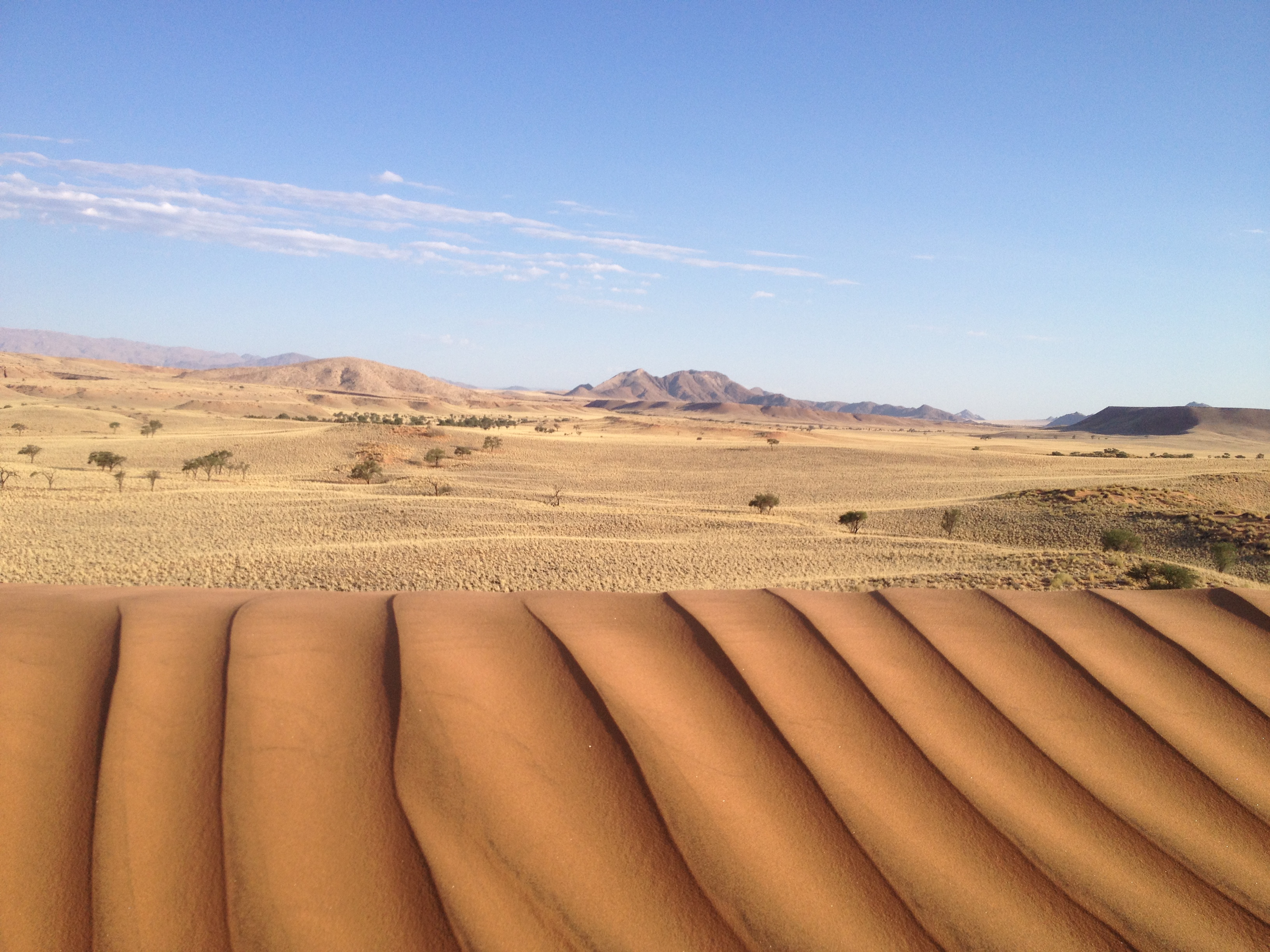
We ended our farm tour with a hike up a hardened sand dune to watch the sun set. It was absolutely stunning. What was even more striking was sleeping under the stars that night. There is something peacefully raw about sleeping outside with nothing between you and the surrounding wilderness. Due to our remote desert location there were no lights, no pollution, and few clouds. I didn’t know so many stars existed; it was overwhelmingly beautiful.

Imagine this was your farm?!

Imagine this was your farm?!

After surviving a night outside with no snake or scorpion bites we continued on to Sossusvlei. Following an afternoon of hiking through a canyon we rested up for a big surprise later that day. The big surprise was a visit to Fish River Canyon which is the second largest canyon in the world next to the Grand Canyon. Just like the Grand Canyon, the pictures do no properly show the beauty and depth of the enormous landscape. In typical African fashion there were no fences or warning signs anywhere at the canyon so we had to take care walking the kilometer long trail to the lookout point. To our delight our guides Colleen and Lucinda had prepared a wine and cheese tasting at the end of the hike for us. It was a lovely way to end the day.

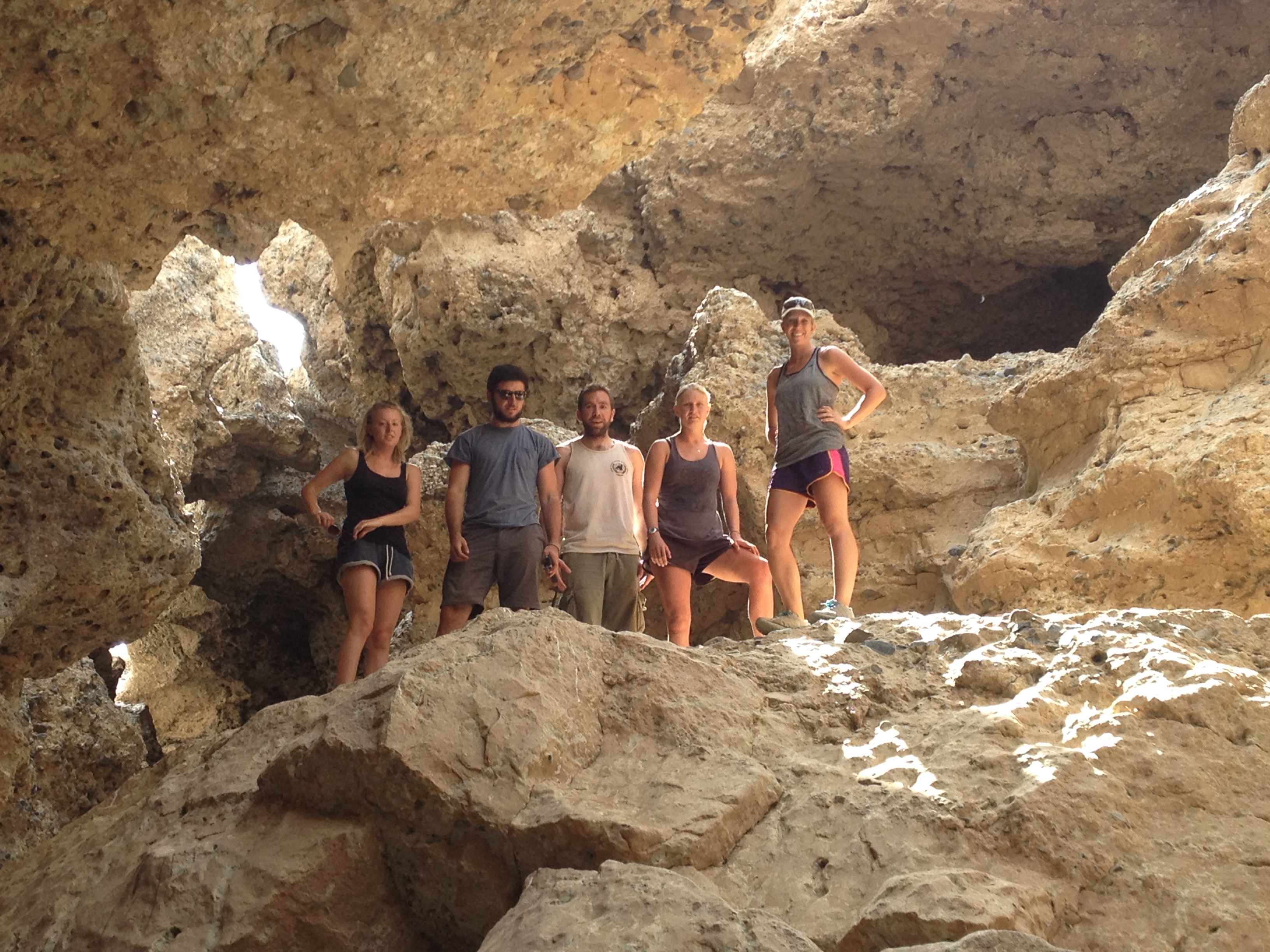
Hiking through a canyon.

Hiking through a canyon.

Fish River Canyon - 160 km long, 27 km wide, and 550 m deep.

Fish River Canyon – 160 km long, 27 km wide, and 550 m deep.

The next day we headed further into the Namib desert, the oldest desert in the world. You could tell it was the oldest desert in the world because the sand grains were so small. It felt like you were walking on icing sugar. The dunes are a glorious red colour because of the tiny bits of metal in the sand that oxidize and rust. Following some intense DangerBall in the pool we took a drive out to the dunes. We visited Big Daddy and Little Mama and the dried up Lake that used to exist before the shifting sand dunes cut it off from the water source.

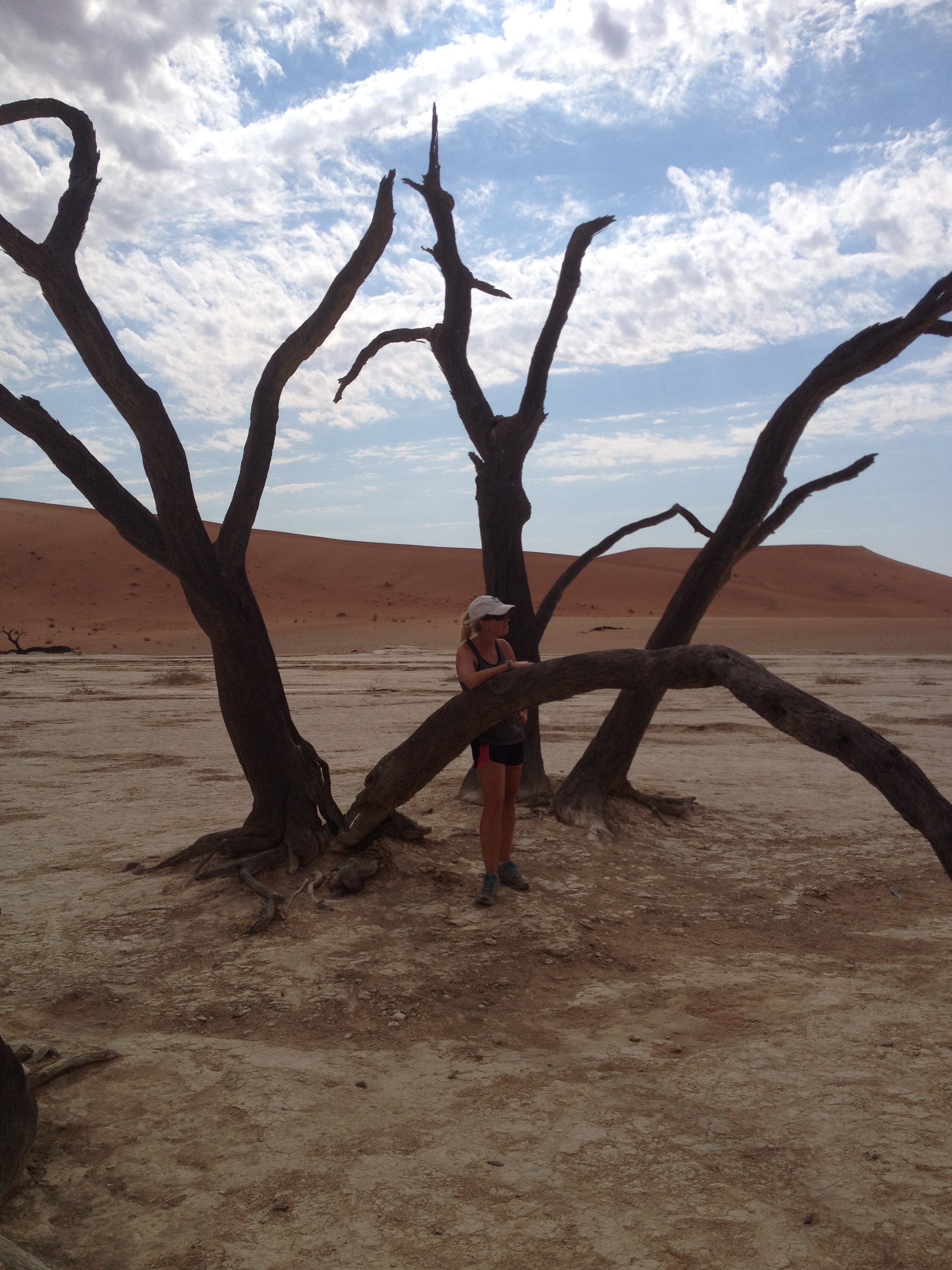
A dried up Lake in the middle of the desert.

A dried up Lake in the middle of the desert.

For sunset we made the trek up Dune 45, the most photographed sand dune in the world. If you’ve never climbed a sand dune I can tell you that it’s really hard work. Fortunately, sand dunes can only grow to a certain height because once the sand hits a 40 degree angle, it rolls down. At the top of Dune 45 we played Danger Dune (last one standing on the peak of the sand dune wins), somersaulted down the sand dune, made sand angels, and eventually watched the sun melt down over the horizon. After that we all used the momentum of the sand dune to run down at top speed. It was way easier going down than up! We fell asleep under the stunning view of the stars again that evening. Even though we had sand all over our bodies and grains infiltrating our sleeping bags, we were happy campers.

Feeling on top of the world at Dune 45!

Feeling on top of the world at Dune 45!

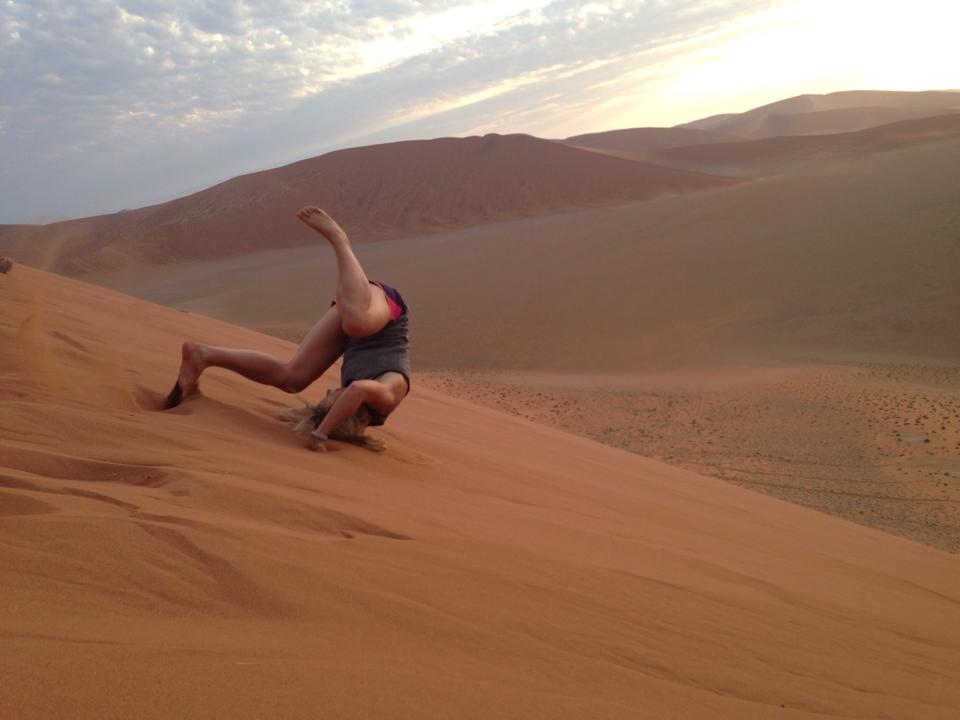
"Danger-saulting!"

“Danger-saulting!”

The next day we crossed the border to our final country on the tour. Stay tuned for The High Class Hobo’s South African adventures!

Waking up to a sunrise over the sand dunes.

Waking up to a sunrise over the sand dunes.

North Namibia

I have skipped writing about the country of Botswana. Actually, I shouldn’t say I skipped it because I have the entire blog written and the photos picked out. Unfortunately that particular post is on my laptop that won’t turn on anymore. I think the poor thing got fried in the desert. Anyway, it’s in an African computer shop now and I’m praying that they can fix it. If they can, Botswana will be posted within the week. So, for now I give you …

North Namibia!

Windhoek is the capital of Namibia (not just the name of a popular African beer) and that is where we stayed our first day upon entering this new country. As far as cities go it was nice. It’s very evident that things are getting more luxurious the farther south we travel.The highlight of the day was going out to dinner at a funky establishment where we tried eating a wide variety of animals we had ogled over on safari the past 30 days. I tried the Bushman’s Special which consisted of kudu, oryx, crocodile, zebra, and springbok. Kudu tasted like steak, the zebra was a gamey tasting beef (no white or dark meat). My favourite was the juicy and succulent oryx and the chewy tough crocodile didn’t even make it down my throat.

The Bushman's Special with Milliepop and Salad

The Bushman’s Special with Milliepop and Salad

The next day we started driving into the desert towards Waterberg National Park. Once there we were excited to go to the pool but to our dismay the baboons had taken it over! This might sound cute but those things are vicious and the males are enormous. Their teeth are longer than those of a lion. We watched them for awhile contemplating our plan to get into the pool area. We could see another group of tourists trapped on a portion of the deck. Surrounded by baboons they had sticks in hand ready to fight; it looked like a scene from Planet of the Apes. Eventually after having a baboon run directly at our biggest human male we took the hint and left.

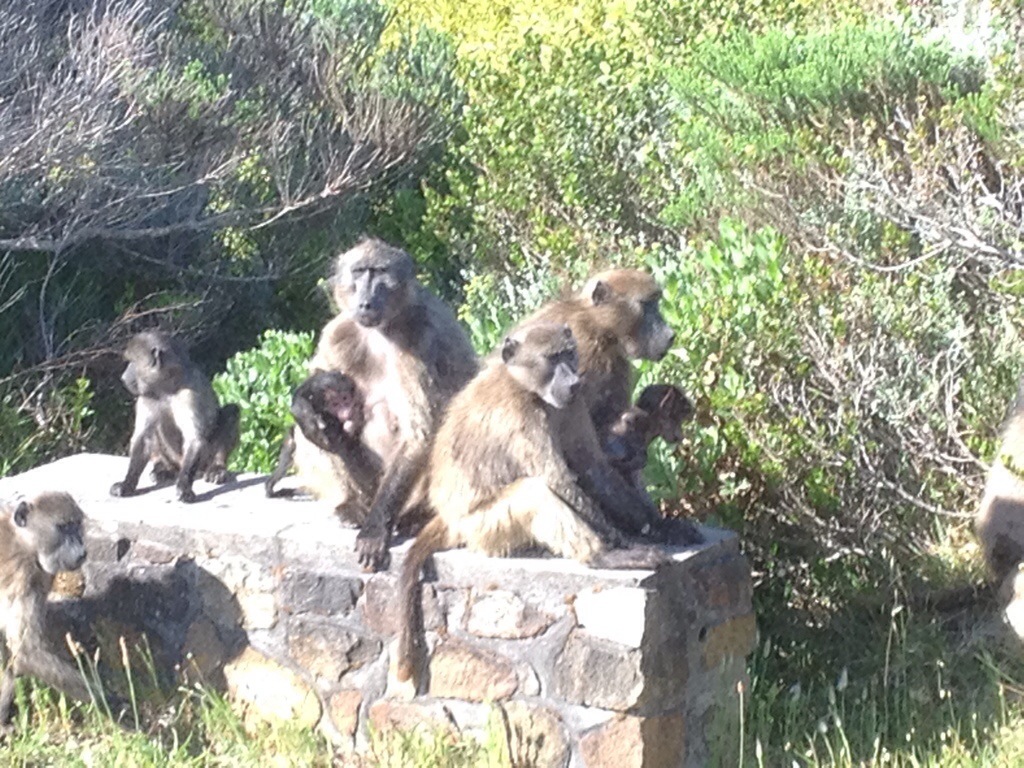
They may look innocent but baboons are crazy!

They may look innocent but baboons are crazy!

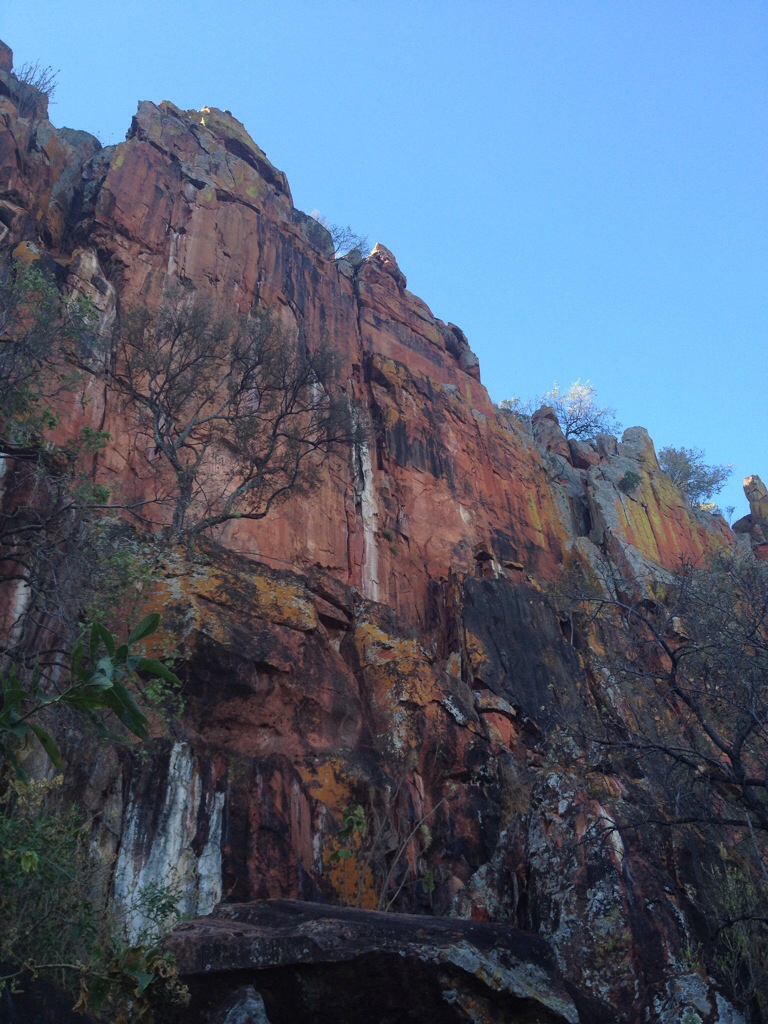
Not all was lost though, we went on an amazing hike up the Waterberg Plateau later that afternoon. The colours in the rocks were incredible and the view from the top into the flat desert land was a scene I could have stared at for hours.

Colourful rock at the Waterberg Plateau

Colourful rock at the Waterberg Plateau

The fabulous view; worth the hike!

The fabulous view; worth the hike!

The following day we headed to Etosha National Park which is approximately 24,000 square kilometres. We game drove into the park and stayed there for 2 nights. We saw the usual elephants, giraffes, zebras, kudu, springbok, and jackals. We also finally saw the last animal we needed to see to complete our sighting of “The Big Five,” – the Black Rhino!!!
Rhinos at the watering hole

Rhinos at the watering hole

There are White Rhinos and Black Rhinos. The funny thing is that they are both grey. The White Rhino was actually called, “wide rhino” because it’s lip is wider and more hooked than the other rhino. There was a miscommunication and someone thought it was named White Rhino, so when they discovered the other rhino they named it the opposite; Black Rhino.

Mama Rhino and Baby Rhino

Mama Rhino and Baby Rhino

Some other highlights we saw on safari were a giant male lion crossing the road in front of us, a rare spotting of a leopard up close, a dead elephant, and two male lions that were eating and wrestling over a springbok they had killed.

Leopard spotting (no pun intended)

Leopard spotting (no pun intended)

We spent our time in the evening at the watering hole. Basically there is a big pond of water with some floodlights shining on it and a fence cutting off the national park from the campsite. You can wander down to the watering hole and sit on a bench or lean against the fence and watch rhinos, giraffes, elephants, and lions come and go to drink from the watering hole. Everyone watches in silence. It’s like a giant movie theatre but way better! …. a great way to spend an evening.
Elephant and Rhino enjoying a drink

Elephant and Rhino enjoying a drink

Our last stop through Northern Namibia was Twyfelfontein which translates to Doubtful Fountain. In this area we strolled among 5000 year old rock engravings created by the San Bushmen. Some of the rock carvings were used as maps to show water sources, others were like chalkboards to teach the children what certain animal footprints looked like, and other pictures such as the human-lion were used for traditional ceremonies.

The "chalkboard" to teach the younger generations about the animals

The “chalkboard” to teach the younger generations about the animals

Our last night before heading to the opulence of Southern Namibia involved a desert walk to look for scorpions. Scorpions glow in the dark so we brought a black light but that was our only source of seeing. We only found one baby scorpion and one crazy-fast, big, white spider. What was way more entertaining was following people around with a little piece of grass and brushing it over their feet or up their legs to watch them jump or swat non-existent scorpions off themselves.

The next day we packed up our dusty tents and headed to a life of luxury waiting for us in Swakopmund!

Only in Africa can you ride an elephant skull!

Only in Africa can you ride an elephant skull!


Zambia

The first night in Zambia we stayed outside of the capital city of Lusaka in a border town called Chipata. There was an immediate difference between Zambia and Malawi. There were way more cars, way more white people, and many of the buildings were made out of cement as oppose to mud brick. These huts had a thatched roof with a pointy top. Zambia’s main income is copper and tourism. Unfortunately the government does not manage the natural resources very well and deforestation is a major issue, but if they are smart enough they may be able to rely on tourism as a source of income in the future.

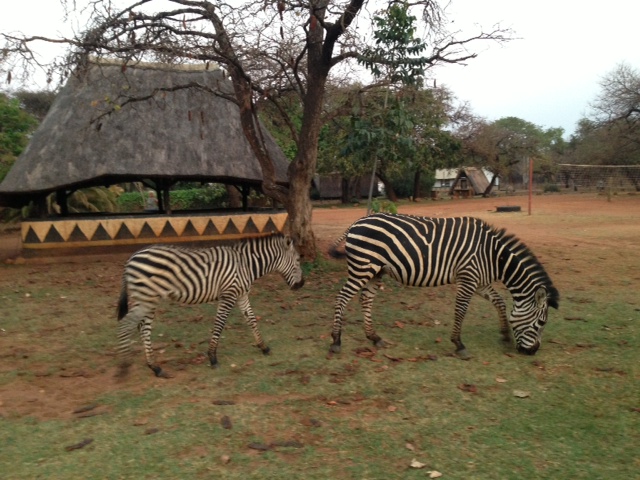
Waking up to zebras outside our tent

Waking up to zebras outside our tent

In Chipata we woke up to zebras roaming around our tent and giraffes not too far off in the distance. A giant dog named Mufasa made sure the wildlife didn’t get to close to the visitors. After a full day of travel we spent 4 days in Livingstone. Livingstone was like entering a whole new world! We stayed at Waterfront Zambezi Lodges and Campground. There was a gorgeous restaurant, bar, and pool area that overlooked the river with the country of Zimbabwe on the other side. The first thing we needed to do when we got there was to book our excursions. Livingstone is an adrenaline junkie’s paradise but this is NOT the place for a Hobo. Livingstone is very expensive so I had to pick and choose what activities I wanted to do the most. Seeing as the bungee jump consisted of 2 towels and one strap around your ankles to hold you in I decided to skip that option. The microflights and helicopter ride were $200 + for 15 minutes which I simply could not justify. Whenever I travel I try to go whitewater rafting. I think it’s a great way to view the scenery, get some exercise, and bond with other people on the trip. The full day raft down the Zambezi River was a no brainer for me. I also decided to dedicate a day to go to Victoria Falls National Park and day to go to Devil’s Pool.

The first day of adventure was rafting. 13/14 people in our tour group also decided to do the full day rafting. Two of those people could not really swim and a few other were not very comfortable with the water. Before booking we watched the promo video of the raft flipping in huge rapids to some extreme music in the background. Those of us that had rafted before assured the rest of the group that the raft flipping was worst case scenario and they were just trying to market the day to look more exciting. I felt really bad once we got on the water because I realized my advice couldn’t have been more far from the truth.

Paddling our hearts out before being flipped into a rapid

Paddling our hearts out before being flipped into a rapid

Our rafting guide’s name was Steve and he had been guiding on that river for 23 years. You know those people that are bored with their jobs so they have to amuse themselves at work so they don’t go crazy? I think this was Steve. He took pure joy and pleasure in watching us struggle. For instance, one of the girls fell out on the first rapid. We pulled her in and in between coughs she told Steve she had swallowed a bunch of water, to which he responded with an ice cold face, “Keep your mouth shut then, Singapore.” I would catch him grinning sometimes when he thought we weren’t looking; he was genuinely amused by what we felt were near death experiences.

The names of the rapids should have been our first hint that the day was going to be intense.

The names of the rapids should have been our first hint that the day was going to be intense.

By the third rapid I had figured out that Africa must have a different way of rating rapids. Rapids can be class 1-5. I have rafted Class 4 and felt perfectly confident and safe but these were a class all on their own! On the rapid named, “Devil’s Toilet Bowl,” our entire boat flipped and I got stuck underneath. They tell you in the safety debrief to stay calm and walk your hands along the raft until you reach the edge. I did that but I wasn’t getting anywhere. After what felt like an eternity (even though it was probably less than 5 seconds) Steve reached under, found me, and pulled me out. Even though he is the least sympathetic person I’ve ever met he is in my good books now.

This wasn’t the only rapid we flipped on. There were 25 rapids total that day and we fell out on 6 of them. Now, that doesn’t sound like a lot but when you are being tossed around underwater in what feels like a washing machine with no idea when you’re going to surface again, it can get pretty strenuous. Once you do surface you then have to take a quick breath because you know you are going to get slapped in the face with another giant wave and go back down again. If you’re lucky enough to have been able to grab the “oh shit rope” that is tied around the edge of the raft you have to try not to get smacked in the head with the bobbing raft or squished between your raft and the rocks on the edge of the river bed. All in all, it was a terrifying outing but one of my favourite days on the trip so far. It was so much fun telling our stories in the bar afterwards and we still talk about it almost every day. At this point in my blog I usually insert some cool pictures. Unfortunately my waterproof, indestructible camera is somewhere at the bottom of the Zambezi River. Like I said, the rapids were a lot more intense than I was anticipating so I naïvely brought my camera.  So there are no pictures of me rafting. 😦

Bird's eye view of the first rapid, "The Boiling Point"

Bird’s eye view of the first rapid, “The Boiling Point”

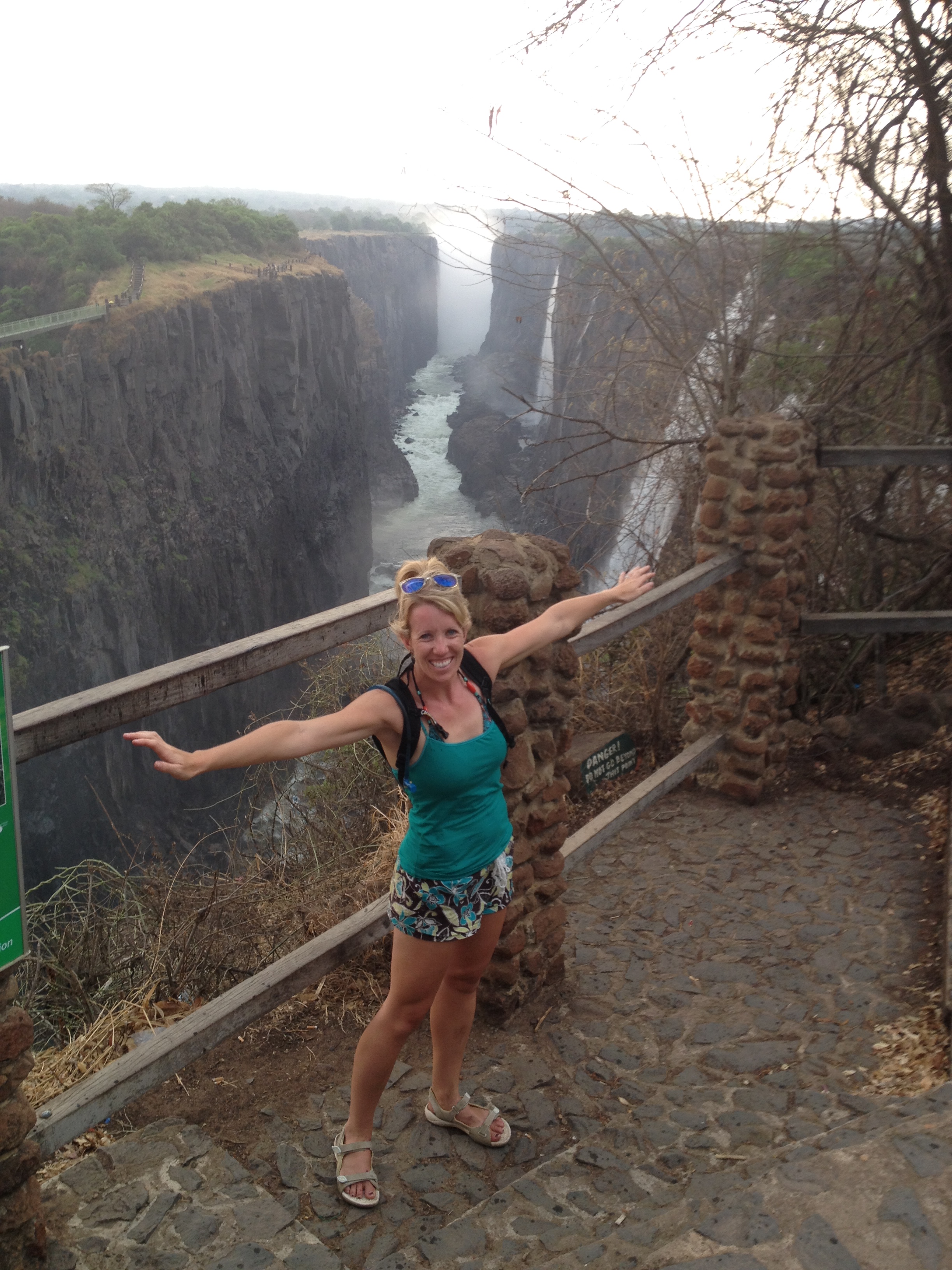
The following day we went to Victoria Bridge which connects the country of Zambia to Zimbabwe. It was here that I watched some of my fellow travelers do the “Big Air Experience” which consisted of ziplining across the gorge, bungee jumping 111 m towards the Zambezi River, and swinging off the bridge. It looked terrifying. In the afternoon we went to Victoria Falls National Park too see one of the Natural Wonders of the World. Mosi-oa-Tunya which means “the smoke that thunders” is original name for the Falls. David Livingstone renamed the waterfall Victoria Falls after Queen Victoria upon his “discovery” of them. One million liters of water fall second down the 108 m cliff into the 1.7 km wide gorge. In the wet season it would looks like a giant, continuous curtain of water. It is the end of the dry season now but it was still a spectacular sight.

IMG_2858

Victoria Falls National Park

David Livingstone plaque

David Livingstone plaque

The following morning consisted of a trip to Devil’s Pool, the most extreme infinity pool in the world. We took a taxi to Livingstone Hotel which was beautiful and cost $800 a night! Needless to say we used a lot of the free moisturizer in the bathrooms and one girl even took some of the nice smelling potpourri to put in her tent. We took a little boat out to Livingstone Island. It’s a weird feeling voluntarily driving towards a 108 meter waterfall drop. When we got to the island we had the chance to stroll close to the edge (no fences, ropes, or warning signs in sight) and essentially get as close as we wanted to peek over the side into the gorge. The Falls were stunning from above and there was a gorgeous double rainbow!

Double Rainbow

Double Rainbow

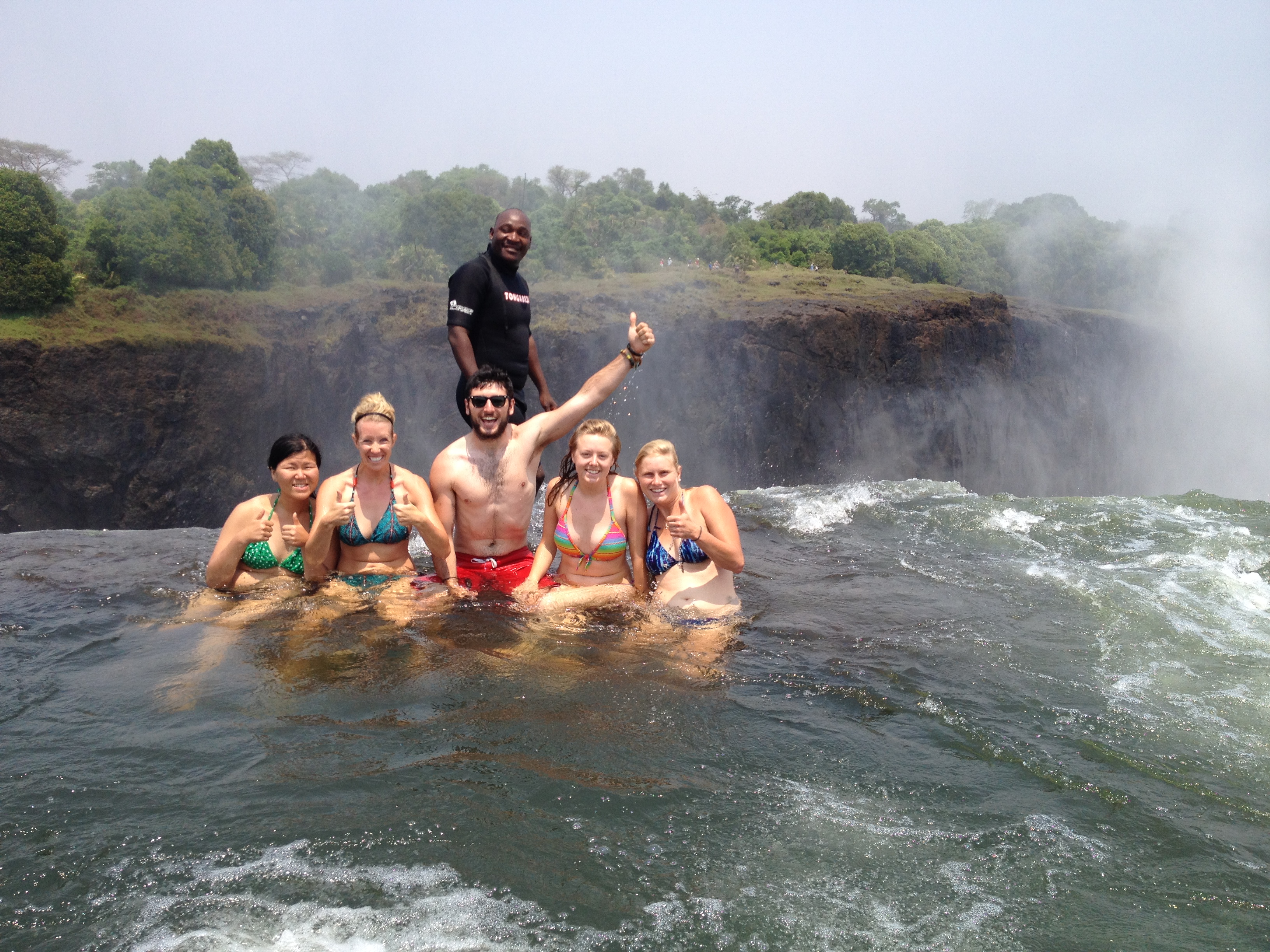
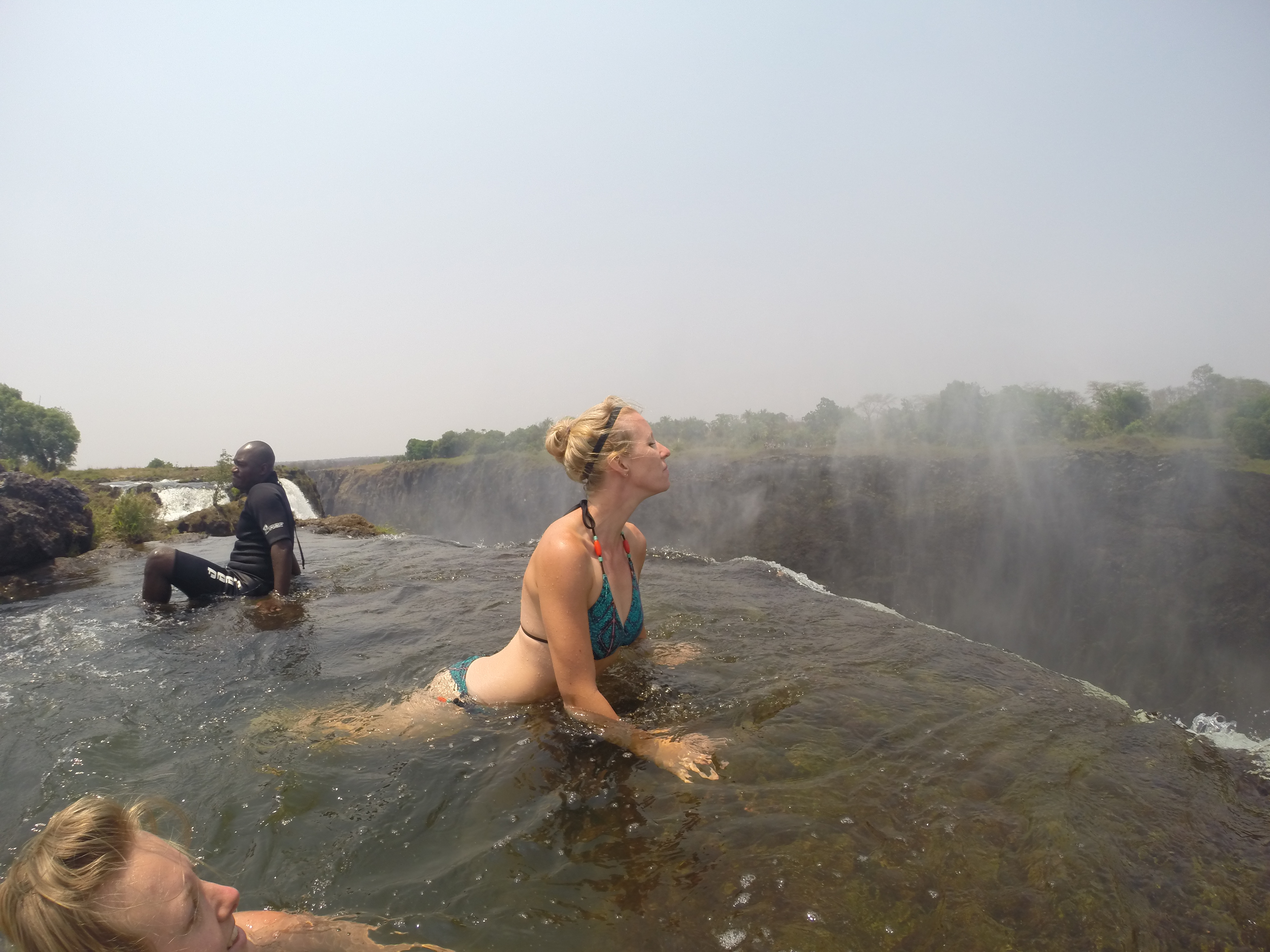
After taking some pictures we were led to a chunk of water we had to swim across. There was a bit of a current but we made it across safely. Once on the other side we climbed up on a rock. The Falls were no less than 10 meters ahead of us with a little pool of water between us and the drop down into the gorge. Our guide backflipped in and simply floated to the edge where he climbed up and STOOD ON THE EDGE OF THE WATERFALL. One at a time we cautiously slipped into the water and allowed the current to push us to the other side where we held onto a little rock ledge so we wouldn’t topple over the falls. Once everyone was in we sat up on the ledge for a picture.

IMG_2913

Sitting on the edge of a waterfall!

As if being nervous about toppling over Victoria Falls wasn’t enough, the Devil’s Pool was filled with little fish that like to eat the dead skin cells from human bodies. So once in a while you’d get a little nibble on your feet, legs, or even bum from these fish trying to get a meal. To get us out of the pool someone threw us a rope and dragged us back to the rock where we battled the current to swim back to Livingstone Island.

Cautiously taking a peek over the edge.

Cautiously taking a peek over the edge.

The next day we hopped on our truck-trolly with our new tour guides Lucinda and Colleen to continue our journey to the border of Botswana. The High Class Hobo had survived Zambia!